
Sucre is Bolivia’s White City and while many travelers enjoy their time spent in the city itself, there’s a lot to do in the surrounding areas. If you like hiking, there’s no shortage of hikes and trails you can do, from day hikes to multi day treks. I signed up for a tour that included a bit of variety. We hiked a section of Bolivia’s Inca Trail, visited the Maragua Crater, and saw dinosaur footprints.
Here’s what that day trip was like.
A Day Trip from Sucre, Bolivia
This is all based on my experience. I booked my tour with GreenTrekkers and while they said it was a four person minimum, some people cancelled last minute and I was in a group with just one other traveler. We still visited all of the main sights along the way, so even though I paid a bit more for the day trip, I still had a great time.
Departure from Sucre
When I booked my tour, I was told to meet in Plaza 25 de Mayo at 8:30 am. That sounds great (especially since so many of my day trips lately have involved being picked up between 5:00 and 7:00 am), but Plaza 25 de Mayo is a large square. I found my guide eventually (they technically found me) and all was good. I paid for my tour and after some money issues with the other guy on my tour, we set out from Sucre.
We were told it was going to two hours until we reached our first stop, but it was just over an hour. Not too bad, all things considered.
The Inca Trail from Chataquila to Chaunaca
The first stop of the day is hiking from Chataquila to Chaunaca. This path was first used by the local indigenous people and was later used by the Inca when they conquered this part of Bolivia. Now, it’s referred to as the Inca Trail.
Much of Bolivia sits at high altitude and Chataquila, where we started our hike was no exception. Sucre sits at about 9000 feet (2700 meters) above sea level, but Chataquila sits at nearly 12,000 feet (3600 meters) above sea level. While that’s undoubtedly high, it’s actually 1,000 (300 meters) feet lower than when I was in the city of Potosi.
Because this area is so high and tour operators want their tourists to have the best experience, they explicitly start at Chataquila. Why? Because if you hike from Chataquila to Chaunaca along the Inca Trail, you’ll be hiking downhill for nearly the entire time. Apart from the random step, there was only one, very short area of uphill hiking which happened at about 11,000 feet (3300 meters).
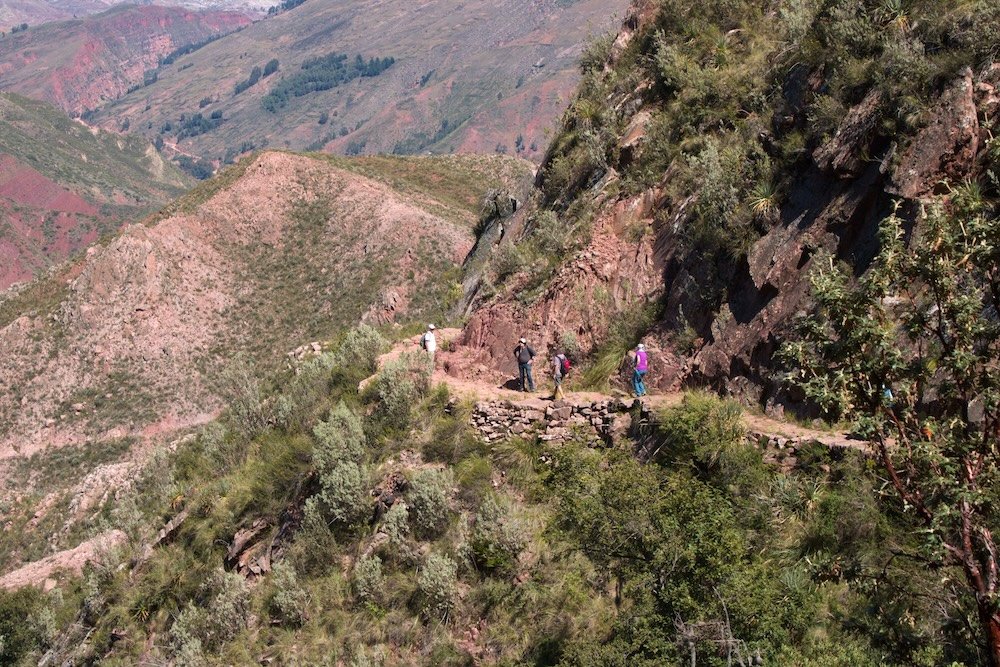
So, as we hiked from Chataquila to Chaunaca, we descended from 11,961 feet (3645 meters) to 9,892 feet (3015 meters). That’s pretty substantial. Meanwhile, my watch only logged 151 feet (46 meters) of elevation gain on the entire hike. And the distance of the entire hike? It was just under three miles (2.85 miles to be specific or 4.6 kilometers).
We kept a pretty steady, but slow pace throughout our hike. So while normally three miles would take me an hour or less (depending on the elevation profile), we actually took 1 hour and 45 minutes to hike this section of trail. Looking at those numbers, it feels incredibly slow, but we passed every other hiker on the trail. It was a very comfortable pace for our tiny group (a guide, a German man in his 50s, and myself), but I feel confident in saying that our guide would have gone even slower if the rest of the group was slower.
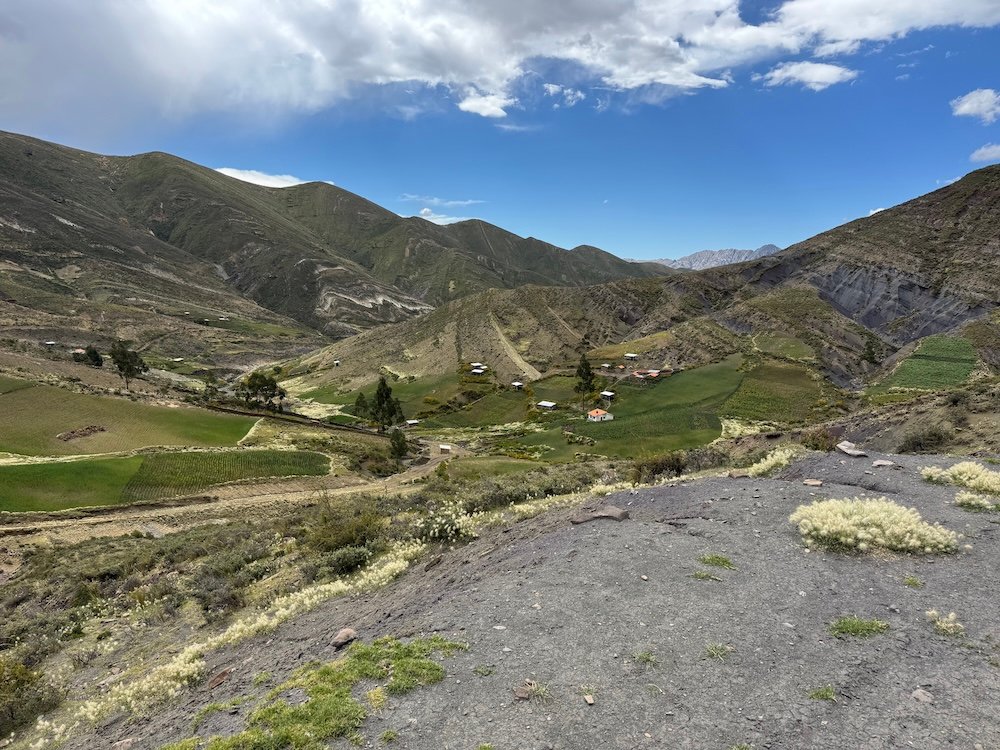
The hike itself was gorgeous and we were surrounded by mountains. Off in the distance, we could see part of the Maragua Crater, which we’d visit later in the day. The only downside is that I couldn’t watch the mountain views the entire time. The trail is lined with uneven stones, so you often had to watch your step to make sure that you didn’t fall over (and for once, I didn’t fall over). But, since we went at such a slow pace and took a few stops for photos, there was still plenty of time to enjoy the views.
Overall, I’d call it a great hiking experience. Sure the terrain was uneven, but aside from the one section of uphill hiking, it was a pleasant, non strenuous hiking experience and I really enjoyed it. It was hard to believe that we were only an hour from the major city of Sucre.
Lunch in Maragua
The nice thing about doing this with a guided tour is that we had both a guide and a driver. This meant that our driver dropped us off at the starting point of the trail in Chataquila and met us on the other side in Chaunaca. The only waiting we had to do was for our guide to fill out a piece of paperwork and pay our fees for hiking the trail. Then we got in the car and headed to the town of Maragua.
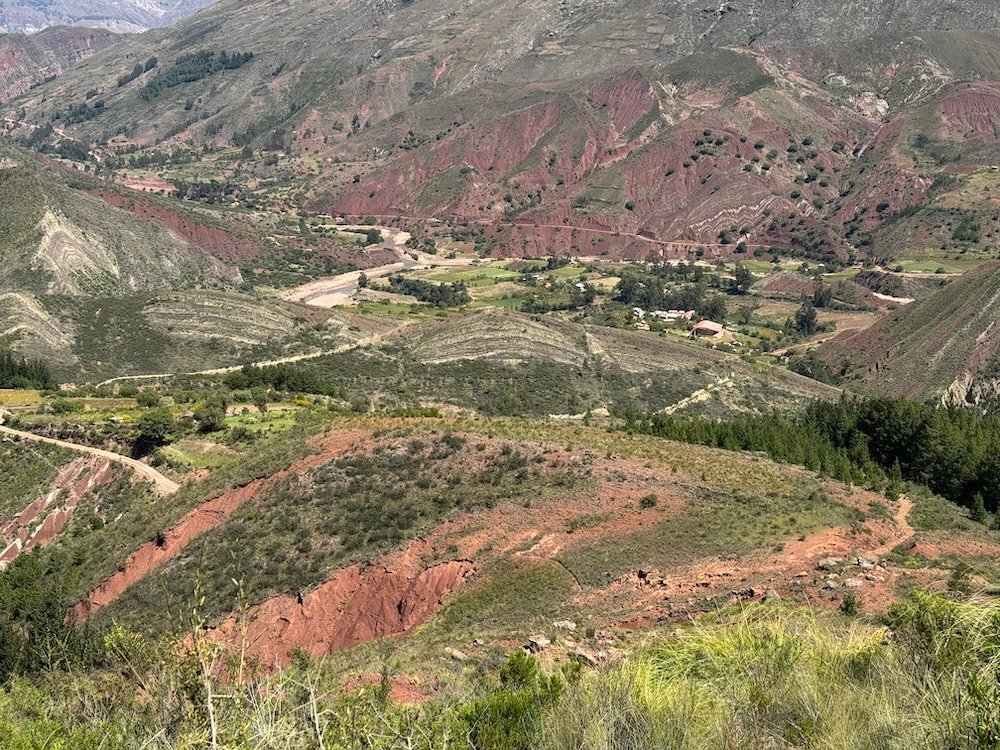
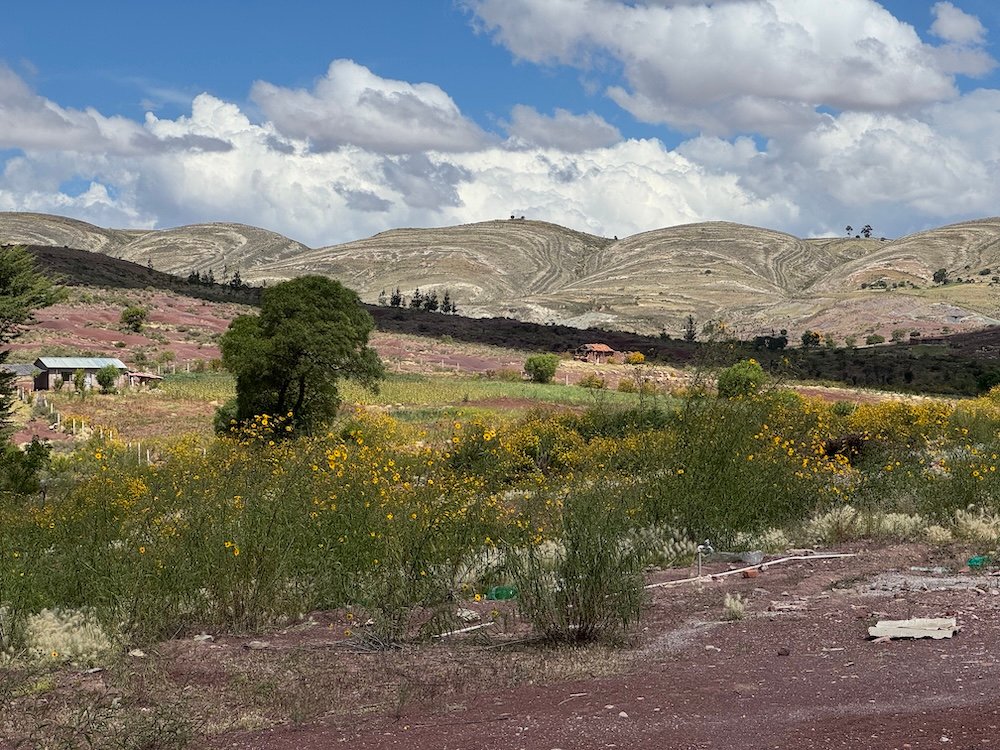
There’s not much in Maragua since it’s a town of just 200 people. There’s a few hotels and a school, but not much else. However, the town sits within the Maragua crater and therefore there are some incredible views.
Since we were a small group of four (two tourists, a guide, and our driver), we got to eat outside at the hotel we stopped at. The other, larger group that came after us, had to go inside. It was so nice being able to just take in the scenery all around us.
Lunch was provided by the tour company, but was very basic. It was a packed picnic lunch with some rice, chicken, and vegetables. Nothing fancy, but it did the job and at least there was some lunch.
Visiting Dinosaur Footprints
We left the town of Maragua after lunch and after some confusion, our guide let us know that we would be coming back. We were a bit concerned that we’d come all this way and that was the only experience of the Maragua Crater that we’d get, but it turns out that we’d be back later for a viewpoint. Our guide was very nice, but the itinerary for the day wasn’t explained very well. To be fair though, neither the German man nor I paid super close attention to the itinerary when we booked this excursion.
When we arrived at the Dinosaur Footprints, we were told that we’d have about an hour walking. It was actually an hour and 15 minutes, but that included our stop at the Dinosaur Footprints.
So what are the Dinosaur Footprints? It’s exactly what it sounds like. In the year 2000, fossilized footprints were found and now the landowner allows tourists to visit (for a fee of course). There’s not many footprints here and if I’m honest, this wasn’t the highlight of the day for me. But it’s still kind of cool to see.
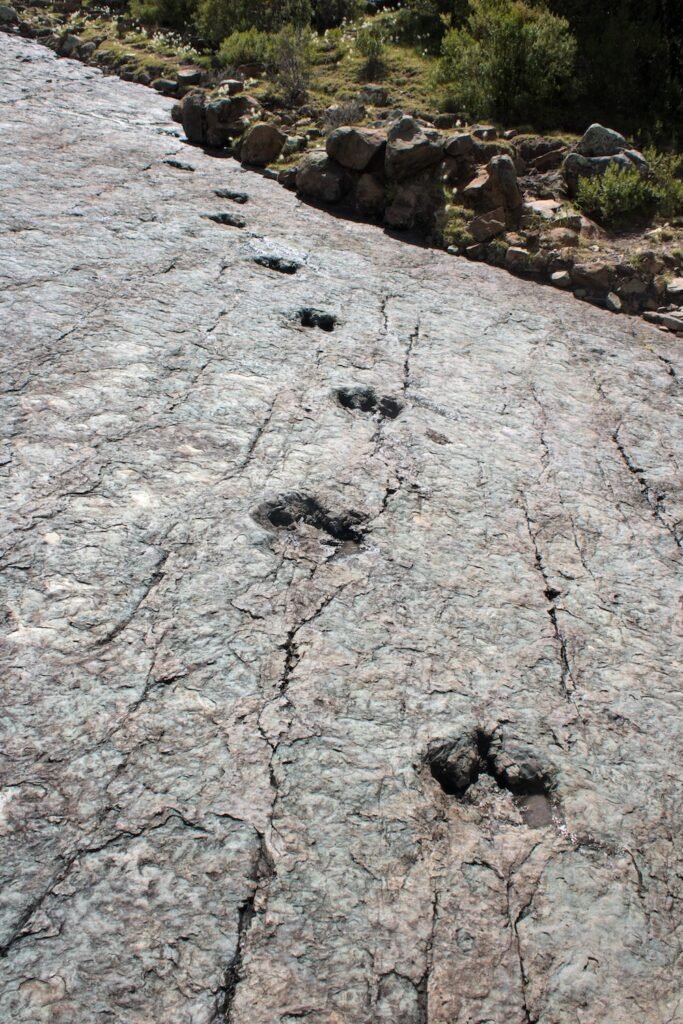
It’s worth noting that these are not the only dinosaur footprints near Sucre. There’s actually a park nearby Sucre that you can visit on your own and see a wall of footprints. It’s a popular thing to do in Sucre, but I skipped it on my visit because the area was under renovation and you couldn’t get very close to the wall of footprints. Recent reviews of the park said it just wasn’t worth it at this point. So, at least I got to see the footprints here.
The hike two and from the Dinosaur Footprints is a bit more intense than the morning hike along the Inca Trail. It’s a shorter hike, coming in at just 2.15 miles (3.5 kilometers), but it’s an out and back trail instead of a point to point. From the start of the trail, we descended 587 feet (179 meters) so on our way back, we had to hike back up. That’s not a lot of elevation gain, but when you’re doing it at 10,000 feet (3050 meters) above sea level, it’s a bit tougher than you might be imagining.
The scenery is also nice here, but I think the scenery along the Inca Trail is better. It also didn’t help that there was a light rain on our way out to the Dinosaur Footprints. The rain stopped, but the clouds still looked pretty ominous near the Maragua Crater.
Learning About Textiles
After our hike, we headed back to the town of Maragua. We stopped along the way for a brief stop to meet a local weaver. She showed us a few projects she was working on and while beautiful, I don’t have any room in my backpack for souvenirs at this point. I will say that the weavings are incredibly intricate and beautiful.
Maragua Crater Mirador
Our last stop was for a viewpoint of the Maragua Crater. It was a quick stop on the side of the road, but it did offer a pretty nice view of the crater. And it was probably the best view we had of the crater all day, just because it can be so hard to really take in the scope of the Maragua Crater.
Back to Sucre
From the viewpoint, we had over two hours back to Sucre. It was a long drive that involved a lot of mountain roads. To make matters worse, it started raining, but thankfully our driver was excellent and I felt safe the entire time. There are no guardrails on these mountain roads and there’s plenty of hairpin turns where you can meet oncoming traffic. So, the roads can be dangerous even without the rain, but I’m thankful for our driver getting us back to Sucre without incident.
Can You Do This Day Trip On Your Own?
There are ways to do parts of the this Sucre day trip on our own, but personally, I think it’s easier to go with a tour operator. You can take local buses to get close to some of the hiking trails, but even locals can get confused on the buses (as I saw locals having to ask where buses were going in the city of Sucre).
If you want to do this on your own, I recommend speaking with someone at your accommodation to understand which buses you need to take and when they leave. My walking tour guide in Sucre helped one person figure out part of their hike, so I know it’s possible.
However, to hike the Inca Trail, see the Maragua Crater, and visit dinosaur footprints all in one day, I recommend booking with a tour agency. I used GreenTrekkers and had a good experience.
More in Sucre
Sucre is the capital of Bolivia (La Paz is the administrative capital and where you’ll find the legislative and executive branches of government). It’s a big city and a favorite of travelers to Bolivia. You can see most many of the highlights of Sucre in just one day, but I’d consider giving yourself more time in the city. Obviously, I recommend having an extra day to do some hiking nearby the city, but you can also consider taking a local cooking class. I took a class with La Boca del Sopa and it was excellent.
Final Thoughts
Sucre is a nice city, but I’m so glad I got out to see a bit more of the area. The scenery surrounding Sucre is incredible and the Inca Trail is a pretty easy hike to experience it more in depth. Whether you hike solo or with a tour, I think this makes a great day trip from Sucre, Bolivia.
Continue Your Adventure
Bolivia: In the capital city of La Paz, there’s no shortage of day trips including hiking at Chacaltaya Mountain, Charquini Lagoon, and Moon Valley. For adrenaline, bike down Death Road. Halfway between Uyuni and Sucre is Potosí, which was once one of the richest cities in the world. In the very north, along Lake Titicaca, you’ll find the beautiful Isla del Sol. And lastly, no trip to Bolivia would be complete without visiting the Uyuni Salt Flats. Learn even more in my Bolivia Travel Guide.

Wow! This was so interesting and when I saw the picture of the dinosaur footprints I had to show the five year-old that I’m babysitting today. He loves dinosaurs and he looked at it and enlarged it and then made it smaller and enlarged it again and he said Julie I think this is a T-Rex. You made his day too. Keep traveling I’m going to keep reading.
Thank you so much! It was definitely quite a surprise seeing your name come through on one of these comments 🙂