
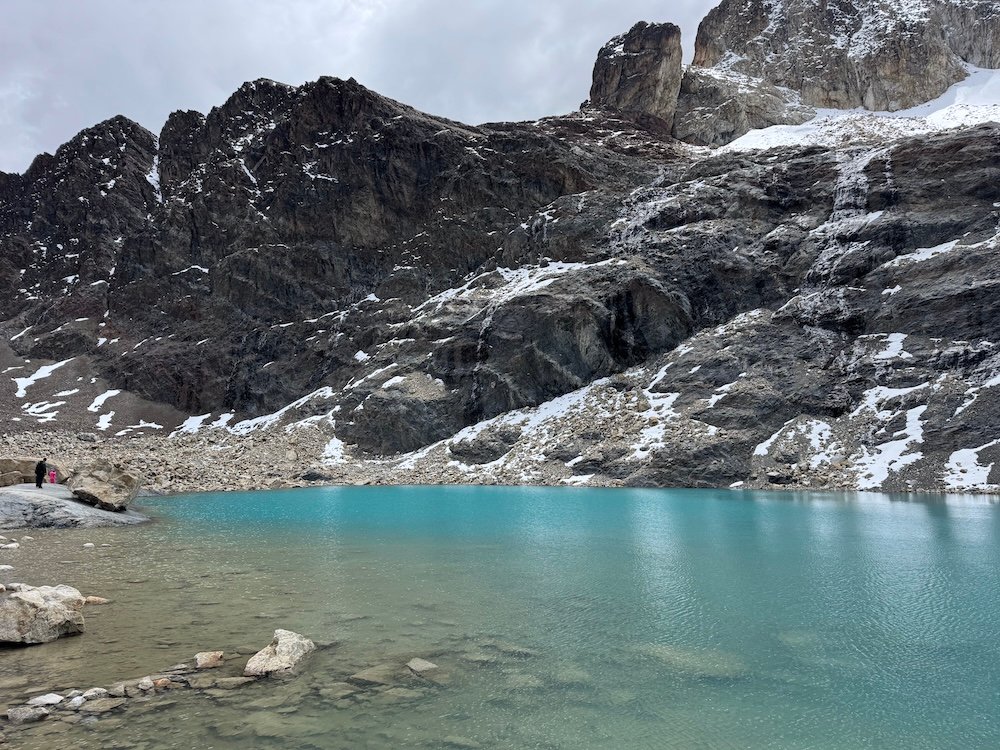
There is no shortage of mountains surrounding La Paz and there are plenty of tours to take you to these mountains. I did several day trips during my time in La Paz and one of those trips was a visit to Charquini Mountain where I was able to hike to the beautiful Laguna Charquini. The hike is difficult, not because of terrain or steep ascents, but because you’ll be hiking at over 16,000 feet of elevation. Your reward for completing the hike is a gorgeous lake surrounded by mountain peaks.
So let’s talk about what it’s like to visit Charquini.
What to Expect on a Tour to Charquini
This is all based on my experience on my day trip to Charquini. While there are several companies that offer a tour to Charquini, nearly ever company will offer a very similar experience.
Getting to Charquini
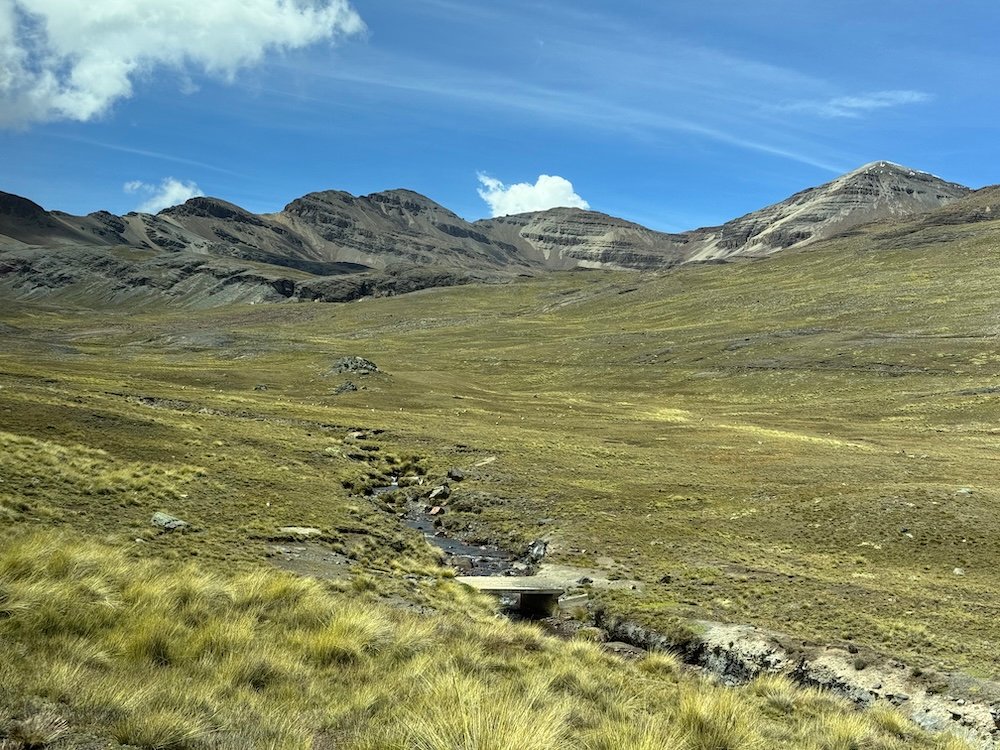
Charquini Mountain is located north of La Paz and the easiest way to get here is with a guided tour. In my case, my tour company picked us up from our hostels and then drove out of the city and into the mountains. We did make one short stop in the city of La Paz. It was just long enough for everyone to go to the bathroom if they needed (for the cost of 2 bolivianos) and grab some snacks and water if they didn’t bring any.
Thankfully, it’s a short drive and at most, it should take about an hour until you reach your first stop. That said, traffic in La Paz is unpredictable and you never know exactly how long it will take.
Photo Stop at Alto Milluni
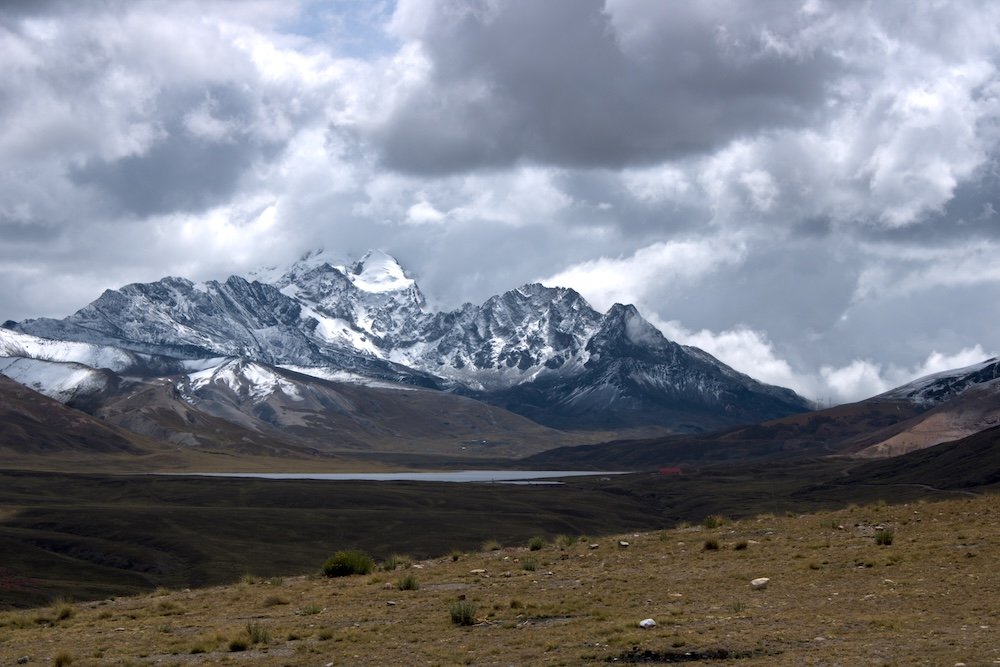
The first stop is at Alto Milluni, which is a photo stop. There’s a sign, like you can find in any city in South America, but there’s also a fantastic view. You’ll be able to see both Huyana Potosi and Chacaltaya from here.
Huyana Potosi is a mountain that sits at over 6,000 meters above sea level. It’s a popular trip for backpackers to climb to the top of the mountain. It’s mostly hiking to the top of Huyana Potosi, but you’ll also get a tiny intro to climbing on your two or three day hike. I skipped the hike to Huyana Potosi since I felt like I was struggling enough when hiking at 5,400 meters above sea level. Huyana Potosi is the white, snow covered mountain.
To the right of Huyana Potosi is Chacaltaya. This mountain is famous for once having the highest ski resort in the world. The ski resort is now closed, but you can still visit Chacaltaya on a day trip from La Paz. Typically, Chacaltaya is combined with a visit to Valle de la Luna. The good news is that you can drive most of the way to the top of Chacaltaya, the bad news is that the road can feel sketchy, especially if it has snowed recently. Chacaltaya is the black mountain to the right.
Take in the view, grab your pictures, and get back in the van for some more driving.
Colored Lagoons
The day before I visited Charquini, I had visited Chacaltaya on a very sketchy road. Thankfully, the road to Charquini is much better. It’s still an unpaved mountain road, so it’s not perfect, but compared to the road from the prior day, it was downright peaceful.
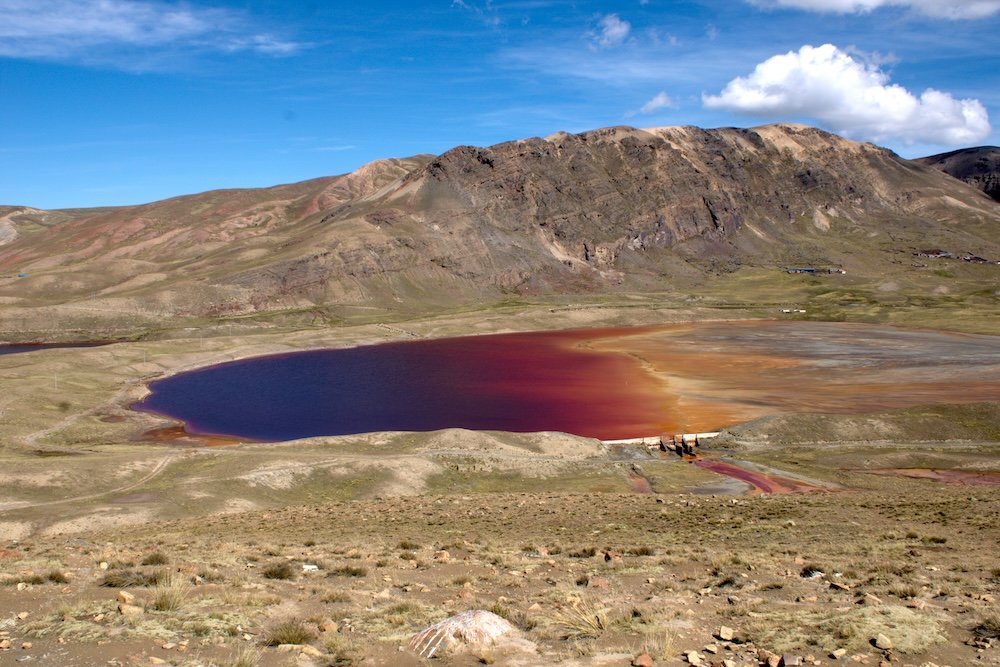
The next stop is just a short way up the road where you’ll stop for some colored lagoons. Get out of the van and take a photo. They are beautiful and incredibly unique. However, the story of the lagoon is a bit sad as these lagoons are not naturally colorful. They are normal lagoons that got polluted from nearby mining. The reds and oranges that you see are from iron while the yellow comes from sulphur.
Milluni Cemetery
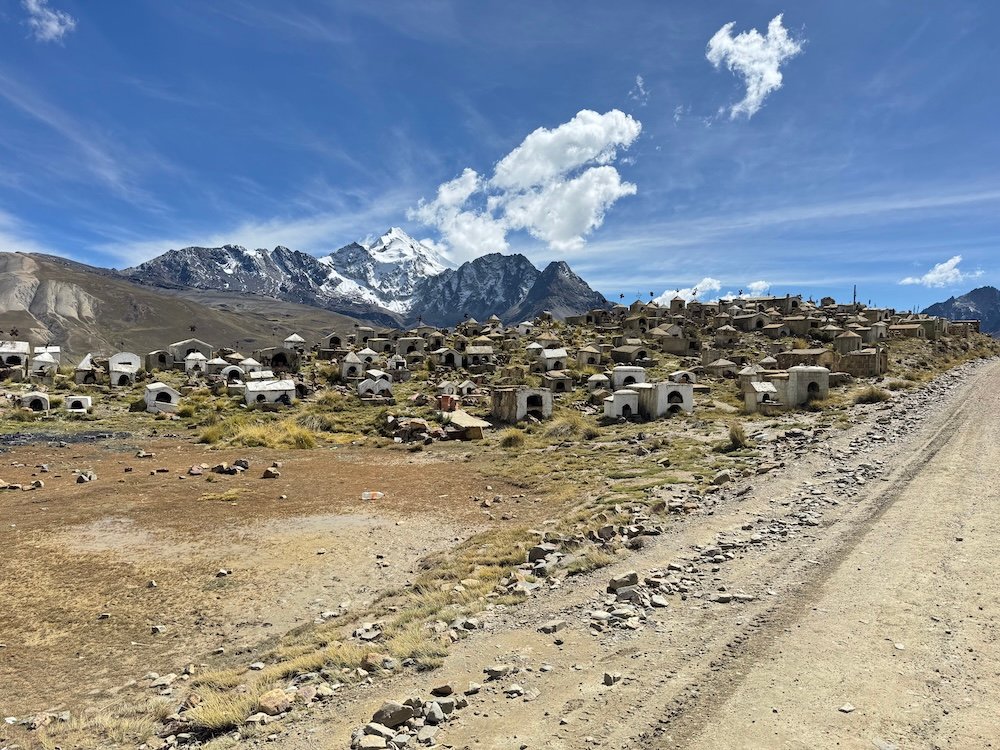
This next stop might feel a bit weird, but you’ll stop at a cemetery. Your guide will give you context for the cemetery, like they will for all stops. However, in my case, our guide gave most of this information in the van and due to the bumpy road and the fact that I was in the last row, I really couldn’t hear her.
However, I looked up the information later because I was a bit curious why there would be a cemetery in seemingly the middle of nowhere. The answer is that the cemetery commemorates a battle that took place in the 1960s between the government and local miners.
A Quick Stop for Food
Not even five minutes up the road, we stopped again at a small restaurant. Here you have a chance to buy some coffee, a sandwich, or a souvenir.
When I booked my tour, it said that we’d have some food included on our tour, but I was confused by the fact that we had to pay at this restaurant. Turns out, the provided food comes later. But since the sandwich costs between 10 and 15 bolivianos (depending on what kind of sandwich you get), it’s really not a big deal.
Finally, you’ll leave the restaurant and then it’s time to start hiking.
Hiking to Laguna Charquini
Well, it’s almost time to start hiking. First you have to pay your entry fee to the mountain. It’s 20 bolivianos, but apparently my fee was covered when I booked my tour online. I’m not sure how that worked out, but I’m not going to complain.
The driver will park the van and everyone will pile out. The guide will pass out snacks (a cheese empanada, a banana, and a chocolate bar). If you want a walking stick, the driver or guide will provide one. Then it’s finally time to start hiking.
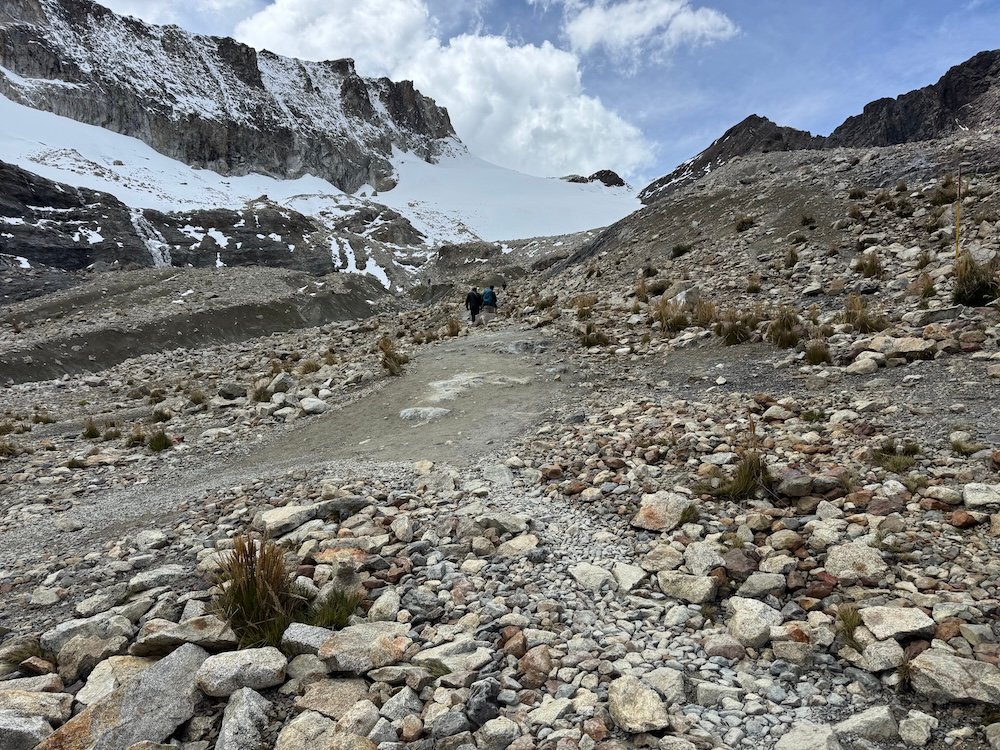
The nice thing about this tour is that everyone is able to go at their own pace. We stuck together for the first part of the hike, where’s it’s pretty flat, but as soon as the incline started, people broke off to go at their own pace. Our guide stuck toward the back with the slower hikers to ensure that everyone made it.
So how is the hike? It’s tough, but I think that the altitude plays a big role in it. Don’t get me wrong, it’s not necessarily easy because you’ll gain about 800 feet of elevation in 1.15 miles. Even if it were lower in altitude, that can still be considered a steeper hill. We started at 15,592 feet and ended at 16,403 feet above sea level. Like I said, it’s not necessarily easy. The good news is that the terrain isn’t bad and though you’ll undoubtedly be slow, it’s still manageable.
In total, it took me just under an hour to reach Laguna Charquini. I arrived, sat down, and caught my breath. Then it was time to take some photos and eat a mediocre empanada in one of the most beautiful places I’ve ever eaten an empanada.
We had about an hour at Laguna Charquini before we started heading back down. Don’t get me wrong, the lake was nice, but one thing that I’ll remember most is that it started snowing. Now, I’m no stranger to snow, having lived in Wisconsin all of my life, but I befriended a Brazilian and two Colombians. None of them had seen snow before so I got as much joy in watching them as they had in seeing snow for the first time.
The descent back to the start of the hike follows the same path you hiked to Laguna Charquini. But, since you’re walking downhill, it’s easier to breathe and you can walk faster. While it took me 55 minutes to reach the lake, it took me just 33 minutes to walk that same path back to the starting point.
Return to La Paz
Once everyone is back, it’s time to head back to La Paz where you’ll be dropped off in the city center. It’s worth noting that you’ll entering the city from the north, so if your hotel is closer to the northern end of the city (mine was just three blocks from the bus terminal), it’s worth asking if they’ll drop you off early. I forgot to ask on this day trip, but the tour company had no problem dropping me off near the bus terminal on my day trip to Chacaltaya.
Should You Do a Tour to Charquini?
The main part of a tour to Charquini is not the mountain views, but the hike to Laguna Charquini. If you just want the mountain views without the effort of hiking at 16,000 feet above sea level, you should look for another tour. While the roads are scarier, a visit to Chacaltaya can offer mountain views without the hiking (though you can hike if you want).
As a note, I talked to two other travelers on my tour. They had looked into visiting Charquini independently, but found that it was just easier and cheaper to go with a guided tour. If you have a slightly larger group (four or more people), you may find it more beneficial to organize a private tour, rather than having everyone pay individually for a larger group tour.
What to Bring on a Tour to Charquini
The most important thing to bring on a tour to Charquini is layers. Laguna Charquini is 4,000 feet higher than La Paz and it is very cold. I like to pride myself in being from Wisconsin and therefore being used to the cold, but I’ll admit that it got cold on the mountain.
For my hike, I wore a long sleeve shirt, fleece, puffy jacket, and a rain jacket. For bottoms I put a pair of leggings on under my hiking pants. I also wore gloves and a hat. While I wouldn’t say I was warm, I was just warm enough during my visit.
Other important things to bring are water, sunscreen, and cash (so you can buy a snack at the restaurant if you’re hungry).
Make sure to wear good hiking shoes. I also brought my own set of hiking poles (since I’d been dragging them around South America for nearly three months), but the tour company provided a walking stick for anyone who wanted one.
More in La Paz
La Paz is one of the capital cities of Bolivia (Sucre is the other) and there’s some interesting things to do in the city. Wander the city center (I recommend a walking tour to get the most out of your experience) or see a cholita wrestling show. Outside of the city, there’s no shortage of day trips. Moon Valley in the southern part of the city offers unique and incredible views.
For those interested in mountains, Chacaltaya is a popular and relatively easy mountain to visit. For more adventure, consider hiking Huyana Potosi, a mountain with a peak above 6000 meters.
If you’re looking for even more adventure, consider taking a biking tour of Death Road.
Final Thoughts
The hike to Laguna Charquini was difficult, but mostly due to the altitude. Still, my day trip to Charquini was excellent and I’d recommend it to anyone visiting La Paz who wants to do a little bit of hiking.
Continue Your Adventure
Bolivia: In the capital city of La Paz, there’s no shortage of day trips including hiking at Chacaltaya Mountain and Moon Valley. For adrenaline, bike down Death Road. Near Sucre, you can hike at the Maragua Crater. Halfway between Uyuni and Sucre is Potosí, which was once one of the richest cities in the world. In the very north, along Lake Titicaca, you’ll find the beautiful Isla del Sol. And lastly, no trip to Bolivia would be complete without visiting the Uyuni Salt Flats. Learn even more in my Bolivia Travel Guide.
