
The Colca Canyon is located near Arequipa, Peru and is a major draw for anyone visiting the area. It’s one of the deepest canyons in the world (nearly twice the depth of the United States’ Grand Canyon) and is also famous for its nearby condors. While plenty of visitors will just visit the Colca Canyon on a day trip, active sightseers can take a two or three day trip and hike down into the canyon.
I opted to hike the Colca Canyon on my visit to Peru. It’s a difficult trek since you’ll spend nearly three hours climbing up and out of the canyon with no breaks on your last day. Even though I knew it was going to be a tough hike physically, my hike turned out to be more difficult mentally than physically.
So, if you’re thinking about doing a two day Colca Canyon trek, here’s what to expect.
About the Colca Canyon Trek
As mentioned, the Colca Canyon is one of the deepest canyons in the world. At its deepest point, it’s more than 11,000 feet (3,350 meters) from the top to the bottom. Thankfully, you don’t climb that section of trail, but that does not mean you’re going to have an easy trek. We “only” climbed 3,000 feet (about 1,200 meters) and that was still a tough climb.
If you’re planning to hike the Colca Canyon, there’s two main choices. There’s a 2 day Colca Canyon trek or a 3 day Colca Canyon trek. The three day trek is obviously more spread out.
For a three day trek you’ll spend one day on the bottom of the canyon. On day one, you’ll hike into the canyon. On day two, you’ll hike across the bottom of the canyon. Then on day three, you’ll hike back out of the canyon.
For a 2 day Colca Canyon trek, you’ll combine days one and two and hike into the canyon and across the bottom. Day 2 of the trek is climbing out of the canyon.

2 Day Colca Canyon Trek
This is based off my own experience on the Colca Canyon 2 Day Trek. While each company will be slightly different (especially when it comes to where you’ll sleep), the overall experience will be the same no matter who you book with.
Day 1 – Before the Trek
Your day starts incredibly early since pick up for the Colca Canyon trek starts at 3:00 am. Yes, 3:00 am. It is early and you’re going to be exhausted, but there’s a few reasons for the early morning wake up. First, it takes time to drive to the Colca Canyon. Second, the tour company wants to make sure that you have a chance to see the condors, which are more active in the morning. Third, you need to start the trek with enough time to finish before dark.
So, sometime between 3:00 and 3:30 am, you should be getting picked up from your hotel. Take only what you need for the next two days and leave your main luggage at your hotel. You want your bag to be as light as possible for the trek.
The good news is that once you’re picked up, you can curl up in your seat in the van and go back to sleep. It’s still dark out, it’s early, and nearly everyone tries to get just a little more sleep. While not the greatest sleep, I do think I actually dozed off in the van for a little bit. At least until our driver slammed on the brakes and sent us flying into the seats in front of us (and our bags flying). I’m not sure what happened but my guess is there was either a llama or alpaca in the road.
About three hours later, you’ll reach your first stop. This is breakfast and everyone will stumble tiredly out of the van and into the restaurant. It’s a buffet style breakfast and it was just ok. That was my feeling for all of the food on the Colca Canyon Trek. It was ok. Clearly I got spoiled while on the Lost City Trek (and again during the Inca Trail) where all of our meals were delicious and filling.
Back in the van, we continued down the road. We stopped to pay our entrance fee for the Colca Canyon (which is not included in your trekking fee and is 70 soles at the time of writing) and then it was onto Mirador Cruz de Condor. There’s several viewpoints of Colca Canyon along this highway, but Cruz de Condor is one of the best places to witness the condors in flight.
Condors don’t necessarily fly. They glide, using the geothermal air to help move them along. Early in the morning, the air is just right and the condors are more active. You should see some condors here, but how many you see depends on your luck. I believe we saw about ten.
We finally reached the trailhead and had the opportunity to change. All of us were wearing pants and jackets for the cold morning air and we wouldn’t need them once we started hiking. There was also one more chance to buy water, snacks, and anything else you might need for the trek. They even had bamboo walking sticks that you could rent for 5 S/. each. I have been lugging my own trekking poles across South America, so I was able to skip the bamboo rentals.

Day 1 – The Trek Begins
Now it’s finally time to start hiking. Kind of. Every group will be slightly different and it’s all up to the guide. From what I saw, some guides will give one really long talk in the beginning and others will have you stop every 5-10 minutes to give you more information. My guide liked to stop to give information.
On the one hand, this was fine because the whole point of traveling with a guide is to learn about the area where you’re hiking. On the other hand, it was over six hours since I had first left my hotel and I was eager to finally get hiking. Stopping every five to ten minutes felt like torture. Just let us hike!
That said, I think in some ways, going like this, especially in the beginning is a good way for the guide to get an idea of the group’s hiking ability. In our group, we had some fast hikers (most of the group), some average hikers (me), and some slow hikers (one couple). During this first section, we were able to stay together a bit more.
But finally, it was time where we could hike at our own pace. We were given instructions for what to do if we came to a fork in the trail and were told to wait for our guide at the other side of the bridge. With that, we were free to hike at our own pace.
I’d say it was about a two mile, completely downhill hike. I’d love to say that I was able to go quickly, but I’ll fully admit I went a bit slower than my normal pace. Much of the trail was rocky and a lot of it was scree and I did not want to fall. Plus, I knew there was one couple behind me, so it’s not like I was completely last (for once!).
Our guide stayed at the back with the slowest hikers, to make sure every one finished and no one needed additional help. Like on the tough sections of the Inca Trail, if you need help, you stay put and your guide will eventually reach you.

Throughout the entire trek, I couldn’t help but compare my experience to the Lost City Trek. On the Lost City Trek, we had our main guide, a translator, and an assistant guide for a group of 12 people. While my Lost City Trek was a bit different (due to my guides carrying a fully assembled museum display case for the first two days), in general there’s always someone with the fast hikers and the slow hikers. On the Colca Canyon trek, we had one guide for 12 people. When there’s a big disparity in hiking abilities (like there was in our group), it really highlights the problem with relying on just one guide.
Out of 12 hikers, I was hiker number 10 to reach the river. This didn’t surprise me and at this point, I’m used to being nearly the last (though often the last) hiker to finish a section. I’m not sure how far behind I was from the rest of the group and I never asked. I didn’t bond with this group like I did with the Lost City Trek, which was a shame.
What I do know is that this downhill section made it obvious that some people were in over their heads. As I keep saying, I’m an average hiker (though I feel significantly slower since I keep ending up in hiking groups with super athletic people) and I finished a full 30 minutes before the last people. It sounds bad to say, but it felt like a much needed confidence boost for me.
From the bridge, we hiked another 30 minutes or so until we reached our lunch stop. Here we’d have nearly an hour to eat and relax before it was time to start hiking again. Lunch was a bowl of soup, ceviche, rice, and potatoes. It was fine, but nothing spectacular.
After lunch, we had to start hiking again. We had made it to the bottom of the Colca Canyon and the rest of the day was “Peruvian flat”. If anyone in South America calls a section of trail “flat”, they really mean that the trail goes up and down and it’s just not as steep. The Lost City Trek had “Colombian Flat” and my day trip from Sucre had “Bolivian Flat” and neither was actually flat. On the Inca Trail, our guide distinguished a truly flat section by calling it “Gringo Flat” (and it felt luxurious).
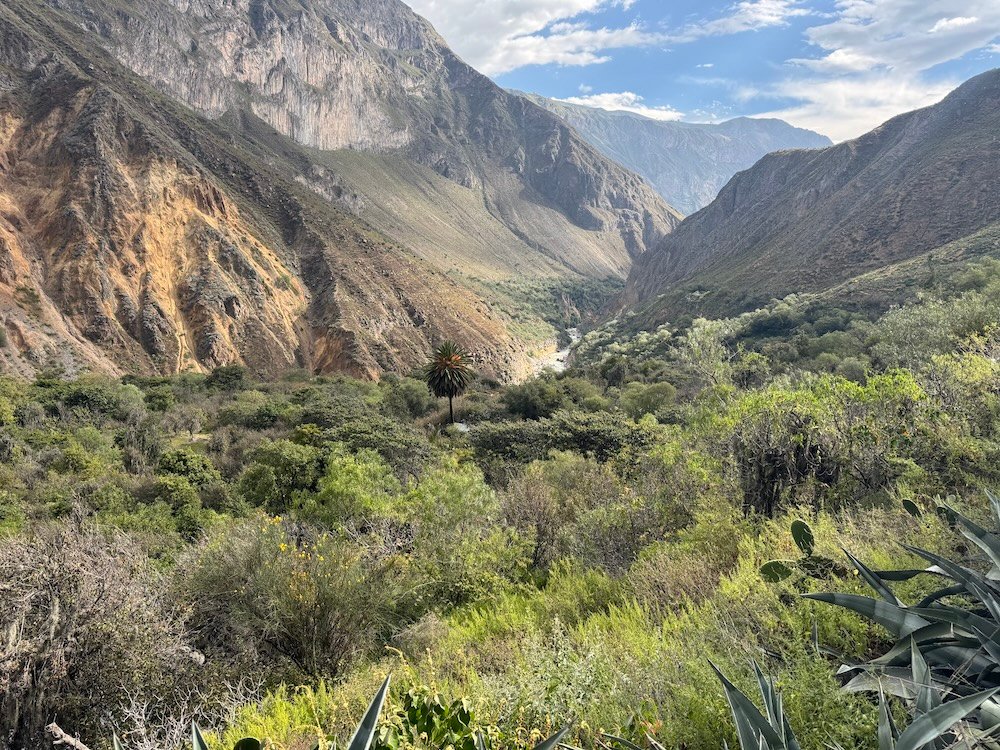
Like in the morning, we stopped often. At this point, our guide was well aware of everyone’s hiking abilities and while he always had something unique to say at each of our stops, I think a big reason for as many stops as we had was to let everyone catch up. This is all fine, but about half way through this afternoon section, we started hearing thunder and all of us wanted to be done hiking before the rain came.
We didn’t beat the rain. It could have been a lot worse, but we still got a bit wet. Thankfully, we finally reached our accommodation for the night before we got soaked. I was delighted that I paid for a shared room and got the entire room (and bathroom!) to myself. It shouldn’t have been a surprise because in our group of 12, there were five couples and the only other solo traveler was a man from France. But I wasn’t complaining about the entire room to myself.
We arrived to our accommodation at 5:00 pm and had two hours until dinner, so I took the opportunity to just relax. It had been a long day. It was a great hike, but I was also exhausted, partially due to the early morning wake up call.
After dinner, we were told that we needed to leave at 4:40 am. That’s better than pick up from the hotel this morning, but still very early. Because of that, when dinner was over (after our guide told us ghost stories of people who died on the trek), I headed back to my room. Shortly after 8:00, my lights were off and I was in bed asleep.
Day 2 – Hiking Out of the Canyon
The second day of the Colca Canyon Trek starts early. I’m not sure what time most groups start, but we started at 4:40 am, which meant that we had to get up even earlier. It was still dark, but I guess that’s why they told us that we needed to bring a headlamp on the trek. I ate a quick cereal bar (breakfast wasn’t served until after we exited the canyon, supposedly due to people experiencing altitude sickness on the way up) and then we were on our way.
I wasn’t surprised to be at the back of the group. In fact, I purposely waited to be the last hiker. The two slowest hikers from yesterday would be taking a mule up to the top of the canyon (for an additional fee), so that meant that I would be last. As I’ve mentioned, I’m used to being the last hiker, so it wasn’t terrible at first.
We started by hiking a bit and then regrouping. While this was good for me, since I was in the back, I think it was more to make sure that we all stayed on the right path. Despite the headlamps, it would have been easy to make one wrong turn. But this didn’t last long.
After our second stop, I found myself falling further and further behind. Again, I wasn’t too surprised since I know that I’m a slow uphill hiker, especially when hiking at elevation (though this was lower elevation compared to many of the other hikes I’d done in Peru). Everyone else flowed ahead and while I could occasionally catch a glimpse of a line of headlamps above me, I was alone.
This is not new to me. I’ve been traveling solo for years and had spend nearly three months in South America by myself at this point. I joined day tours occasionally, but for the most part, I was by myself and I really don’t mind it. This trek however was different.

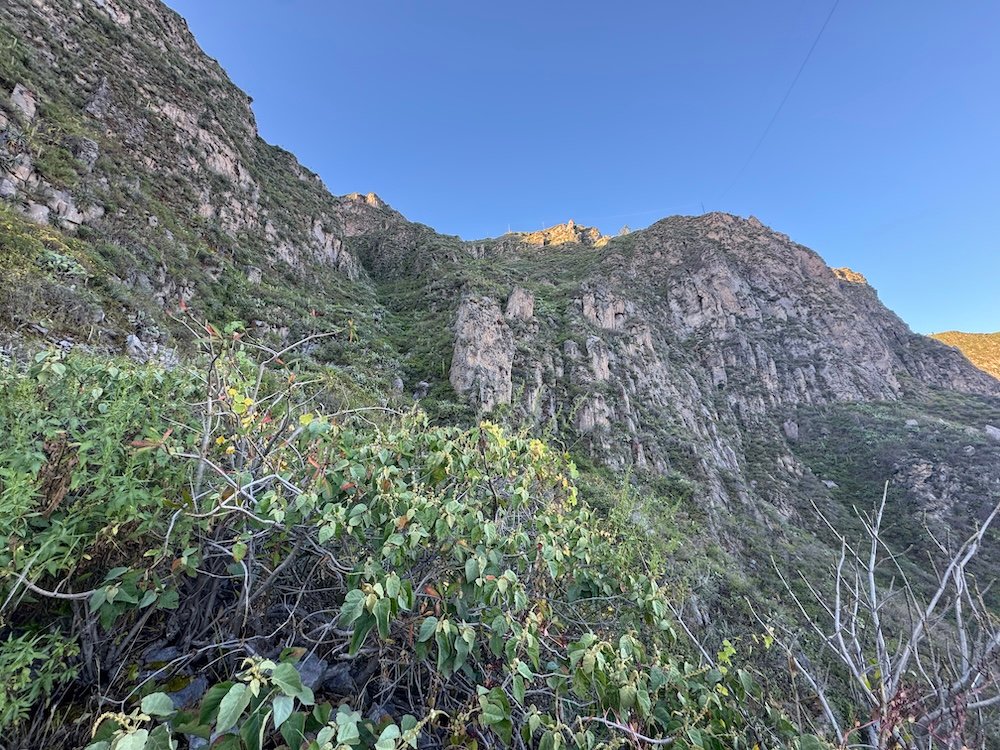
It’s a long, tough climb out of the Colca Canyon. In total, it took me about three hours (and I only stopped when I met up with the group in the very beginning). While I’ve done longer solo hikes, there was something different here. I think it was because I knew the rest of the group was way ahead of me and all but one other person had a partner. I was alone (even the guide was ahead of me for half of the trek) and that meant I had to rely on myself.
That’s not necessarily a bad thing, but when you’re exhausted and lonely, it’s tough to provide the motivation for yourself. I kept putting one foot in front of the other. Slow and steady as I kept climbing to the top. I could see the rim getting closer, but it’s deceptive. I eventually met my guide (who was waiting for the last hiker, which was me) and he told me this was exactly the halfway point. I thought I was further than that so that kind of sucked.
But I had no choice but to keep moving. Our guide was now right behind me, but that didn’t do much to help all of those thoughts in my head. We passed a man, who was another tour guide, and my guide and him talked in Spanish for most of the climb up. I think that somehow made it even worse. At least when I was alone, I could just focus on the sounds of nature rather than people having a nice conversation behind me. But I had to keep going.
Knowing that everyone else was so far ahead of me, I didn’t take breaks. Instead, I kept moving, albeit very slowly. I was however forced to take a break when the mules carrying the slow couple from yesterday passed. That was something, but then it was climbing, climbing, and more climbing.
I eventually reached the top and I’m not even sure what I was feeling. Prior to hiking out of the canyon, I assumed that I’d be filled with a sense of accomplishment when I reached the top. I didn’t really feel that. I think I just felt numb and overwhelmed at what I just did. Tears started to fall and I think was all of the emotions of the morning finally catching up with me. I made it, but it was hard, lonely, and exhausting.
At that point, I would have paid for a private area to just sit and let all of the emotions come out, but that wasn’t an option. After a short break, our guide announced he wanted a group photo, which is just what I needed at this point. But I went over and took the photo. I never got a copy of the group photo but given that I didn’t really connect with anyone on this trek and I was left to hike myself, I’m not really that upset about it.
I probably sound a little bitter, and maybe to an extent I am. The hike didn’t go how I had hoped and while I don’t blame others for going at their own pace, I wish I could have gotten just a little bit of encouragement from literally anyone besides myself.
We still had a half hour more to hike until we reached breakfast, but this was Peruvian flat. Compared to what we just did, this was nothing. Of course now one couple wanted to talk to me (since I had just traveled from Salta, Argentina to Arequipa and they were doing the reverse of what I did). Where was that earlier when I could have used any distraction from the physical effort?
We made it to breakfast and after the tough morning, breakfast felt disappointing. We got two pieces of bread, eggs, and some avocado. It felt nowhere near enough to replenish all of the calories we had just burned, but that’s what we got.
The hike was over and we should all feel accomplished. Even now, as I write the first draft of this post a week later, I’m still not sure what I feel about that second day of the trek.
Day 2 – After the Trek
After the trek, we eventually had to make our way back to Arequipa, but we made a few stops along the way. The first was 45 minutes down the road and for the cost of just 15 soles (less than $5 USD), we could soak in the hot springs. This felt really good after a long morning of hiking.
Next was lunch. We had eaten just three hours ago and when our guide told us we would be stopping at a buffet for 45 soles (nearly $13 USD), we all balked at the price (since you can typically find a menu del dia for 25 soles or less). Well maybe the tour company knows what they are doing because let me tell you, every single one of us got our money’s worth. I’m pretty sure all of us had at least three full plates of food. Was it excessive? Maybe. But I don’t think any of us quite realized how hungry we were until we sat down to eat.
Lastly we stopped at some viewpoints. Of course we had to stop to take photos of llamas and alpacas, but we also stopped at a viewpoint of Mismi Mountain. This is the source for the Amazon River, which unfortunately flowed down the other side of the mountain. Oh well.
Back in Arequipa, we went our separate ways. I got back to my hotel, took a shower, and crawled into bed for some much needed sleep.
Colca Canyon Trek Stats
Here’s how the trek actually breaks down in terms of mileage, elevation, and time.
By Section
Day 1 Morning – 4.9 miles, 374 feet of elevation gain, 3,425 feet of elevation loss, 2 hours 30 minutes
Day 1 Afternoon – 3.5 miles, 915 feet of elevation gain, 1,677 feet of elevation loss, 2 hours 30 minutes
Day 2 – 3.75 miles, 3,665 feet of elevation gain, 62 feet of elevation loss, 3 hours 30 minutes
By Day
Day 1 – 8.4 miles, 1,289 feet of elevation gain, 5,102 feet of elevation loss (nearly one mile!), 5 hours
Day 2 – 3.75 miles, 3,665 feet of elevation gain, 62 feet of elevation loss, 3 hours 30 minutes
Total
Distance: 12.15 miles,
Elevation Gain: 4,954 feet
Elevation Loss: 5,164 feet
Total Hiking Time: 8 hours 30 minutes (this doesn’t include any breaks)
How Difficult is the Colca Canyon Trek?
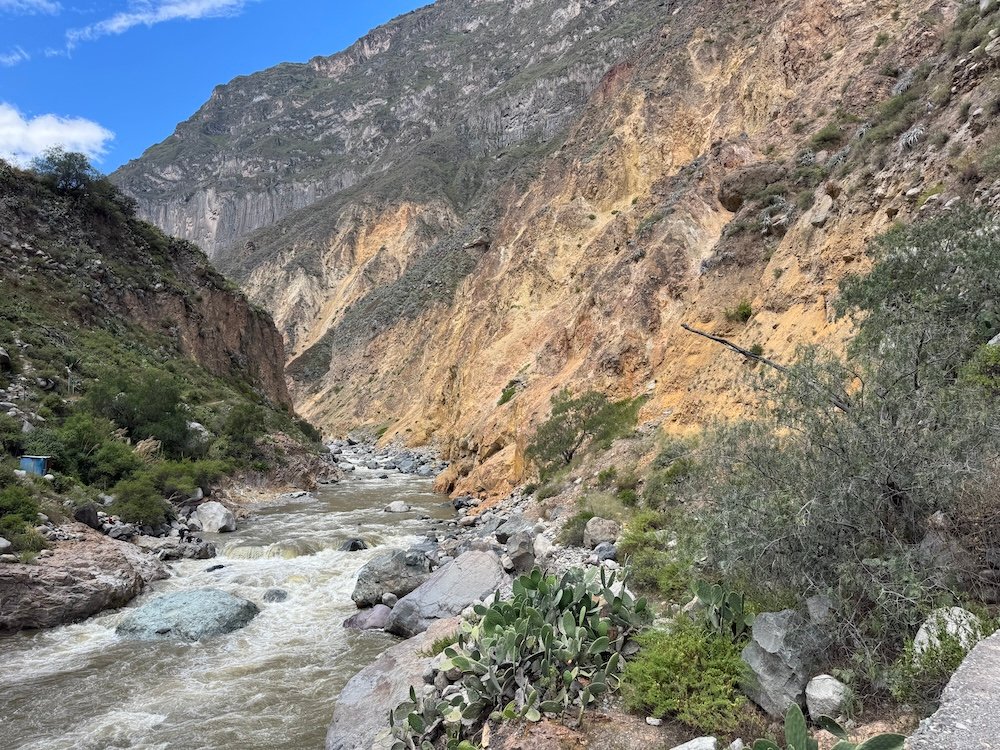
I’m not going to lie. The Colca Canyon Trek is difficult, but I think that difficulty is mostly due to the climb out of the canyon on day two. Now, that’s not to say that the first day is easy, but I found the first day to be much easier than the second day.
On the first day, you’ll descend into the canyon, which while steep, is still totally doable. For me, the hardest part was keeping my footing as there were a lot of sections that were just scree. As we hiked along the bottom of the canyon, it was Peruvian flat, so there was a decent amount of up and down, but I think this was still manageable.
The climb out of the canyon is tough. As mentioned, there’s less to see and the guides more or less let their groups go at their own pace. If you’re a slower hiker, this can be very challenging, especially if everyone else in your group is faster than you. At that point, I found it to be more of a mental struggle than a physical one. My legs were exhausted by the end, but I still made it.
It’s also worth noting that you can hire a mule to take you to the top of the canyon so you can skip the climb. This option is great for those who completely underestimated the Colca Canyon trek and didn’t realize what they were signing up for. Two people on my tour went up by mule. I’m a slow hiker, but I was finishing on day 1 significantly before them. I can’t say if the guide encouraged them to use the mules, but for them, I know the mules were the right decision.
Can You Do the Colca Canyon Trek on Your Own?
While many people choose to do the Colca Canyon Trek with a group tour, it can be done independently. You will still have to pay the proper entrance fees, but I did see some people doing the trek on their own.
There’s two ways to do this. The first is to arrange everything yourself, including your transportation to the starting point and from the ending point of the trek. The second is to look into transportation only tours.
On my tour, we had one girl who rode with us on the bus to and from the Colca Canyon. She paid for her own meals (ours were included with our tour price), her own accommodation, and set off on her own when we arrived at the Colca Canyon.
Despite not loving my group, I’m still glad I did the trek as a guided tour. I think it just took a lot of the stress out of the equation. While it would have been nice to go at my own pace (particularly on day one), the trade off you make is that everything else is taken care of.
Final Thoughts
It should come as no surprise that I have mixed feelings about my Colca Canyon Trek. I’m glad I did it, even if my second day wasn’t great. It’s a difficult trek and one that you shouldn’t take lightly. Make sure you are aware of what you’re signing up for before you actually book your tour. Otherwise, you might be in for a rough two days.
Continue Your Adventure
More Hikes in Peru: The most famous hike in Peru is the Inca Trail to Machu Picchu. Once there, you can also hike to Huayna Picchu. From Cusco, there’s no shortage of great day hikes. Rainbow Mountain is the most popular, Ausangate 7 Lakes was my favorite, and Huamantay Lake is also an excellent choice.
More in Peru: Learn how many days to spend in Lima, Peru’s capital. No trip to Peru would be complete without a visit to Cusco and Machu Picchu. I really enjoyed Arequipa which is also a great base for visiting the Colca Canyon. For different scenery, head to the beach town of Paracas for Las Ballestas Islands or to cycle the Paracas Reserve. The desert oasis of Huacachina is always a hit and the Nazca Lines are a bucket list item for many. In the south, visit Puno and Lake Titicaca. Get even more info in my Peru Travel Guide.
More Hikes in South America: In Colombia, consider the Lost City Trek or hiking part of the Camino Real. In Bolivia, you can hike the Maragua Crater near Sucre.
