
While most tourists to Serbia will inevitably spend time in the capital city of Belgrade, I think it’s worth escaping the city on a day trip. While there are several Belgrade day trips to choose from, I chose a guided tour that would take us to the highlights of Eastern Serbia. Specifically, we’d be stopping at the famous Manasija Monastery and the Resava Cave. Both are attractions in their own right and can be visited separately, but also work together nicely for a day trip due to their close proximity.
It’s a long day trip from Belgrade, regardless of whether you take a tour or visit on your own, but it can be a great way to see more of Serbia than just its capital city.
Best of Eastern Serbia from Belgrade
My trip to eastern Serbia focused on three main attractions: the Manasija Monastery, the Resava Cave, and the Veliko Waterfall. After being picked up from our hotels within the center of Belgrade, we headed east toward our first stop (the Manasija Monastery).
There’s a lot of driving in this day trip, but your guides try to make it a little more tolerable by taking the scenic route so you can see a bit of rural Serbia. That definitely helps to soften the blow of all the driving on a 10 hour day trip.
While these views are nice, the main goal for today is to visit the big tourist attractions in this area.
Manasija Monastery
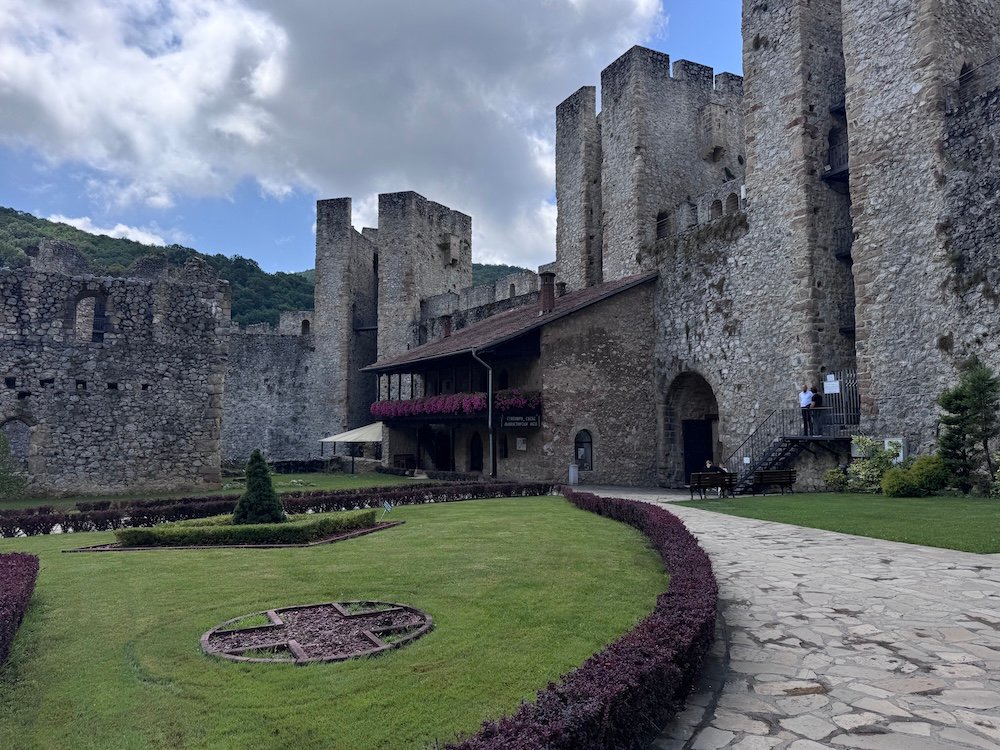
The Manasija Monastery is one of hundreds of monasteries scattered across Serbia’s countryside, but it’s also one of the most famous. The monastery itself is unique in that not only will you find a church (the Church of the Holy Trinity) and a place for the monks to live, but you’ll also find that the monastery itself surrounded by a fortress.
The monastery was originally founded in the early 1400s and has been active ever since. That means that this monastery has survived five centuries Ottoman occupation, occupation from the Hapsburg’s Austria-Hungarian Rule, two world wars, and the formation and collapse of Yugoslavia. Do you understand why they needed to build a fortress around it?
Some of those time periods were more difficult for the monastery than others and over the years it was abandoned at periods, but the monastery itself still survives and is active today.
So what makes this monastery so special? Well, there’s a lot of reasons, but for me, I found it interesting as our guide told the story of how the monks would copy books here. This would become invaluable at preserving Serbian history. The originals were destroyed during occupation but these copies made by monks meant that the history was not lost and when Serbia finally became free again, they still had their history.
At the Manasija Monastery, you can visit the Holy Trinity Church. This Orthodox Church had its frescoes heavily damaged, but parts still remain. You’ll also find a tomb that was believed to be that of Despot Stefan Lazarević, who was a Serbian leader and the founder of the Monastery, though it’s later been proven that his body is entombed in a different monastery.
It doesn’t take long to walk around Manasija Monastery, but the setting is beautiful and with its importance to Serbian history, it’s no wonder why you’ll find so many Serbian tourists visiting. While there were other international tourists at the monastery during my visit, it seemed to be significantly more popular with Serbian tourists.
Resava Cave
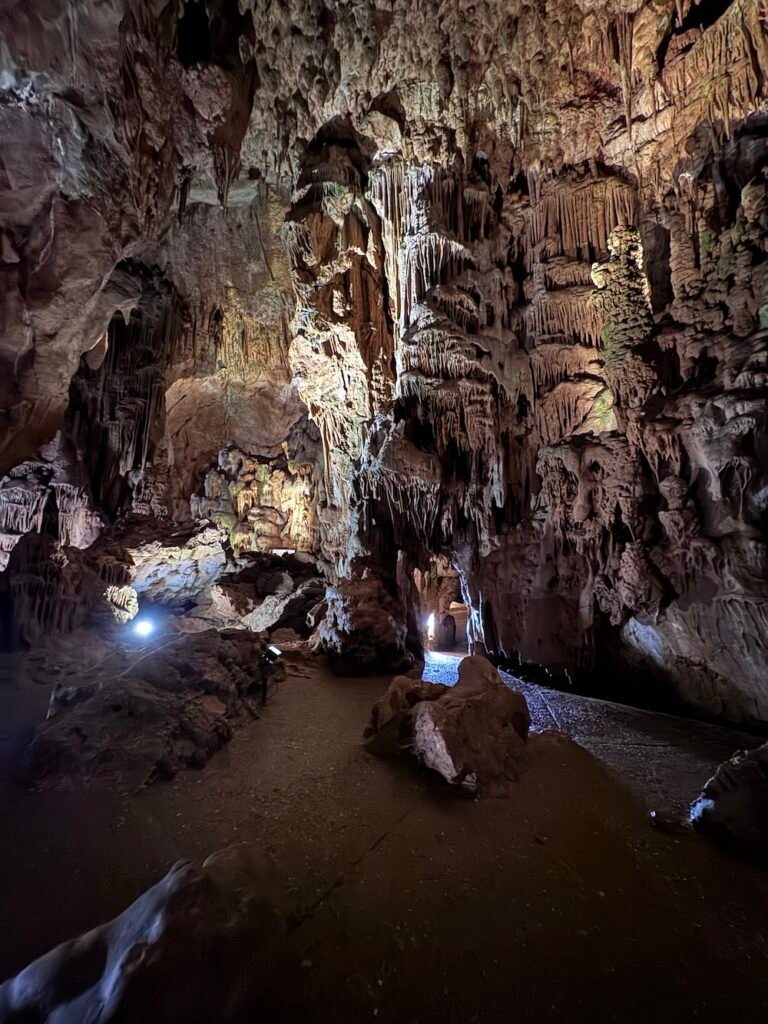
The Resava Cave is just a short drive from the Manasija Monastery, which is why so many people will combine a visit to both locations. So what is the Resava Cave? Well, it’s exactly what it sounds like. It’s a cave that’s now open for tourism.
In the 1960s, a farmer lost a sheep and discovered the cave which had been slowly developing for millions of years. After a few years of study, the cave was deemed stable and now it can be visited by the public. Note that you must visit on a tour and are not allowed to visit on your own. If you’re not already on a guided tour, you’ll have to join with a Serbian group to enter the cave.
I was a bit skeptical of Resava Cave just because I’ve visited plenty of cool caves before. There’s Mammoth Cave in Kentucky which has hundreds of miles of passages, plus there’s Jewel Cave in South Dakota and the amazing Carlsbad Caverns in New Mexico. I’ve even visited smaller caves like Maquoketa Caves State Park in Iowa and some caves closer to home in Wisconsin. Because of all of these cave visits, I just thought it would be something similar.
In some ways, Resava Cave is just like any other cave. There’s 800 meters of paths that you can walk through and your guide will point out some of the neat features. The tour isn’t as in depth as what I got on a ranger led tours through US National Parks, but I think that’s ok. For me, the visit to Resava Caves was more about general sightseeing than a deep geological history.
The cave starts out cool, but about halfway through, you’ll enter the main chamber and this has the coolest formations. It’s the highlight of the tour even though you’ll still have another few hundred meters of cave to walk through.
Despite the numerous caves that I’ve visited, I’d say this cave is pretty cool. Maybe not as cool as Mammoth Cave, but definitely impressive and worth the stop.
Veliko Waterfall
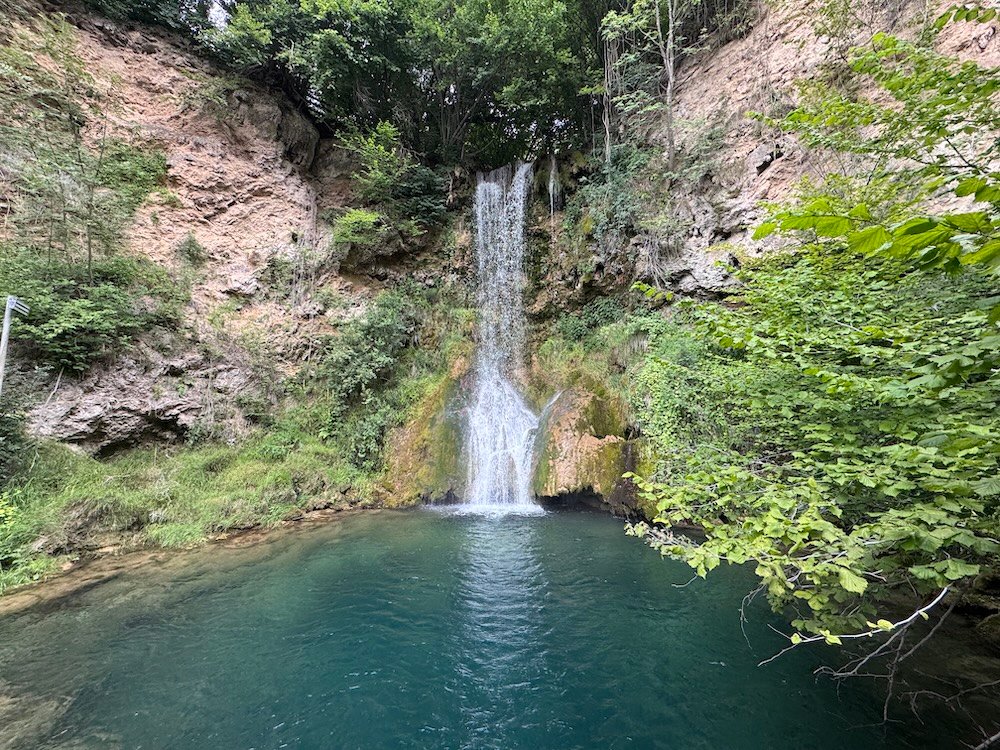
Our last stop at the day was the Veliko Waterfall. It’s nice, don’t get me wrong, but it doesn’t have the same wow factor as the Manasija Monastery or the Resava Cave.
However, there is one thing that the Veliko Waterfall has that these other stops don’t and that’s a restaurant with a great view. This is where we stopped for lunch on my guided tour and I can attest that the food was delicious. I had the trout which is caught from the local river and it was fantastic.
How Long is a Day Trip to Manasija Monastery and the Resava Cave?
I was picked up shortly after 8:00 in the morning and returned my hotel at about 5:30 pm. That means it was over ten hours, with most of that time spent driving from location to location.
As mentioned before, the guides try to take the scenic routes to show you more of the Serbian countryside, but there’s no getting around the hours spent just driving from location to location.
Should You Rent a Car or Take a Guided Tour?
Obviously, there are some huge benefits to having your own vehicle in Serbia. You can travel at your own pace and stop at even more sights along the way. If you’re planning to visit more in Serbia beyond the big cities, I think a car rental can be a very good idea. Belgrade is nice, but it’s also so much more scenic in the Serbian countryside.
So why did I take a guided tour? I’m a solo traveler and for me, the guided tour was the simplest solution. I didn’t have to worry about driving (though the roads in eastern Serbia seemed more relaxed than what I experienced on a subsequent day trip to western Serbia) and I had a guide to give me just a little bit of context.
I think for solo travelers or those with limited time, it’s just more convenient to take a guided tour. If you’re a small group, it may make more financial sense to rent a car.
If you do take a guided tour, I recommend VictorTours. I booked two tours with them through GetYourGuide, but you can also find more information on their website. They were a great company and I would absolutely recommend them for your Belgrade day trip.
One of the things I really appreciated about this tour company is that they keep their groups small. Rather than a huge tour bus, it’s a group that’s capped at eight people since that’s all they can fit in their van.
Can You Visit on Your Own Without a Car?
No. You’ll either need to rent a car or take a guided tour if you want to visit the Manasija Monastery or the Resava Cave. There is no public transportation to these locations.
Final Thoughts
If you’re looking for a taste of rural Serbia, consider a day trip to the Manasija Monastery and the Resava Cave. Both stops were great, but what I really appreciated was the drive through Serbia’s countryside. Escaping the city of Belgrade for the mountains and small villages was delightful.
