
Hiking the Inca Trail brings many emotions. Over four days you’ll ascend into the mountains of Peru to hike over mountain passes and back down as you work your way to the legendary city of Machu Picchu. If you’re like me, you’ll also get added stress and anxiety due to mess ups with my booking. Despite that, the Inca Trail was incredible and truly a once in a lifetime bucket list item and I’m so glad I hiked it.
Here’s what my Inca Trail experience was like.
What is the Inca Trail
The Inca Trail can be a bit misleading because the Incas constructed thousands of miles of trails throughout their empire. I actually hiked a portion of an Inca Trail in Bolivia.
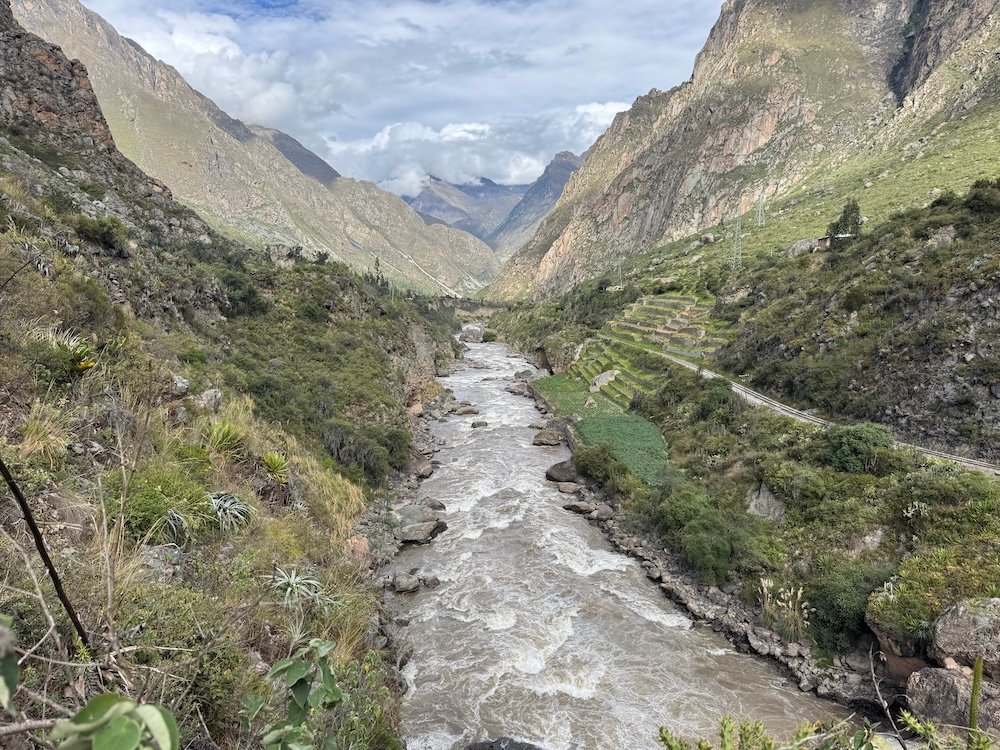
However, traditionally, the Inca Trail refers to a 26 mile route starting near Ollantaytambo and finishing at Machu Picchu. It’s a difficult four day trek through the mountains of Peru, but it’s a bucket list item for so many, including myself.
Choosing Your Company
I booked with Alpaca Expeditions. While expensive, they have some of the best reviews out of any company operating Inca Trail treks. I wish that I could say that everything went perfectly and it was fantastic, I did have some issues.
I had originally booked a 5 day trip which promised a slower pace. We’d still complete the trail in four days, but the mileage was a bit more spread out since we’d arrive to Machu Picchu in the afternoon on day 4, rather than shortly after sunrise.
However, about ten days before my trip the only other couple on that route cancelled, so I was the only person left in the group. I was given the option of a private trek or to move to a traditional four day trek. Neither option was ideal, but I moved to the traditional four day trek.
The problem was all of my Machu Picchu permits were purchased with the 5 day trip in mind, so on day 4, I had to split from my main group. Things got more chaotic from there, which was unfortunate. I still got everything that I was supposed to and it all worked out in the end. However in that moment, it was not a pleasant time. A huge shout out to my parents for listening to me vent for days.
While I had my issues, I do have to give Alpaca Expeditions credit for trying to make it right. After I returned to Cusco, we talked and I was given a partial refund for all of the headaches, stress, and anxiety of days 4 and 5 of my trip.
So would I recommend them? If you’re booking the traditional 4 day/3 night Inca Trail and have no special needs, absolutely use Alpaca Expeditions. If you’re booking one of their modified Inca Trails, I’d be a little more hesitant. I wouldn’t outright say no, but I’d look at all of your options before making a decision.
Hopefully I’m a rarity, though, and I was just incredibly unlucky. After all, it’s not their fault that the only other people who signed up for my trek cancelled with short notice.
About the Inca Trail Route
As mentioned, every tour company doing the Inca Trail follows the same trail, but each company stops at different places. That said, just because a company advertises a certain route with certain campsites, doesn’t mean you’ll get that. We did not follow the traditional Alpaca Expeditions route, so our campsites and lunch spots were different than what was advertised online. We only found this out at our orientation briefing the night before and it definitely came as a shock.
For my specific trail, these changes worked out for me the best. Rather than an incredibly difficult day 2, we had a difficult day 2 and a very long day 3. Everyone in my group was totally ok with this and in fact, we preferred this to what was advertised.
We did ask our guide why our route was changed and he told us the government gets the final say. Kind of. Guides will work with other guides and can sometimes make arrangements on the trail to switch campsites.
The whole point of this is to say, there’s no guaranteeing exactly what your route will be. My 4 day/3 night Inca Trail followed a modified route. The Alpaca Expeditions group who left the next day for the 4 day/3 night Inca Trail followed the route on Alpaca Expeditions’ website.
So this post will be based on my experience, but I’ll note where we deviated and what would have happened if we had followed the traditional Alpaca Expeditions route.
Hiking the Inca Trail
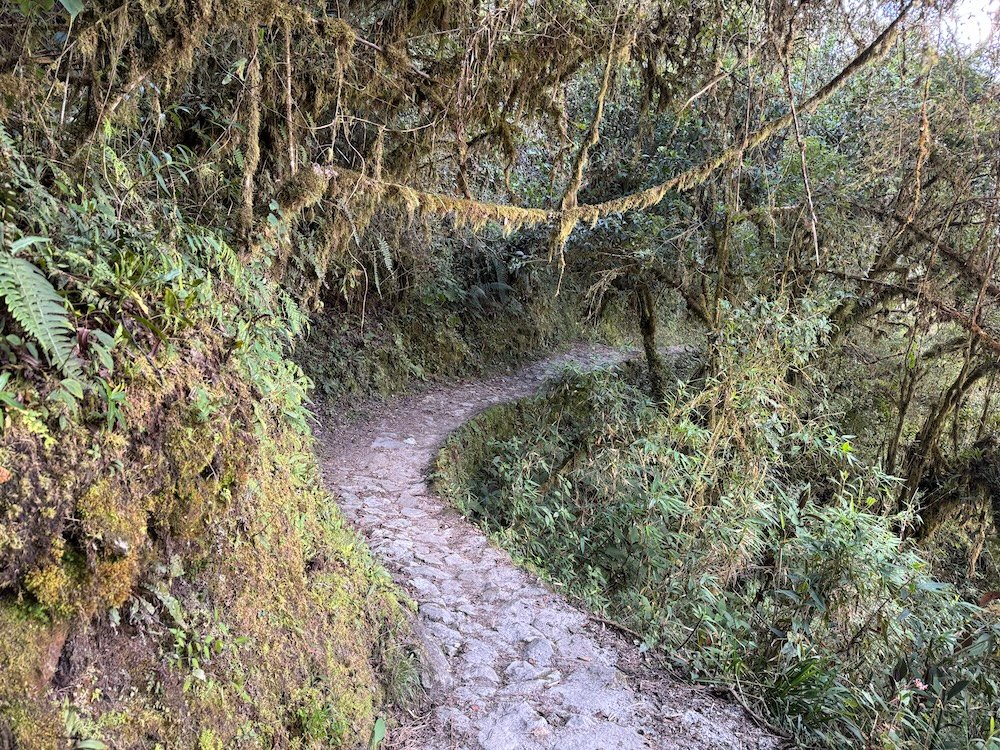
This is my own experience on the Inca Trail. While every group who hikes the four day Inca Trail will follow the exact same route, there will be differences due to campsites, food, and all those little things that vary by company to company.
Day One – The Warm Up Day
Like all tours in Cusco, the Inca Trail tour starts early. We had attended orientation the night before and had been told to expect pick up between 4:00 and 4:30 am. As I’ve mentioned, my trek got a little bit wonky so at 4:25, I started to worry that I may have been forgotten. At orientation, my information was stapled to a second sheet while all of the other hiker information was together on the front page. I’d spend the rest of my trek reminding my guides to turn the page whenever we had to present permits.
At 4:28, there was a knock at my hotel. I guess it was technically hotel pick up like was promised, but I was not picked up in the van. Instead, I walked with the assistant guide to the Alpaca Expeditions office to meet the van that had apparently picked up everyone else. Not a great start, but at least I wasn’t completely forgotten.
The rest of the bags were loaded into the van and then we set off at about 4:45 am, bound for Ollantaytambo. I tried to get a bit more sleep but the road was very bumpy. On the way back to Cusco several days later, I’d see that it looked like some rock slides took out part of the road and the rest of the road was filled with potholes. Not ideal for sleeping, but I, and the rest of my tour group, did my best.
We made a quick stop in Ollantaytambo. Here would be our last traditional toilets for four days and our last chance to buy any last minute supplies (or so they said… there were small little shops throughout the trail until lunch on day 2). Back in the van, we picked up two more hikers in Ollantaytambo (they got to have a bit of a sleep in) and then we arrived at kilometer 82.
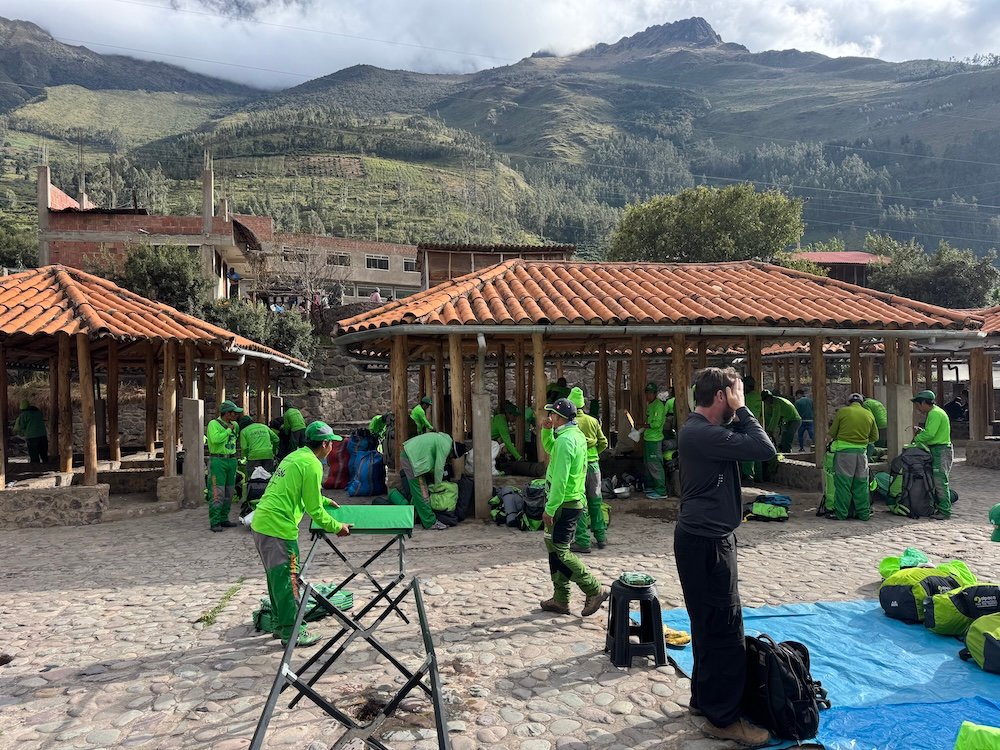
This is the starting point of the Inca Trail and the staging area for every company. It can feel chaotic when you arrive as porters are set up everywhere packing bags and getting organized. Meanwhile tourists are arriving to sit down for breakfast and meet the people they’ll be trekking with for the next four days. Somehow though, it’s organized and makes perfect sense.
We sat down for breakfast which consisted of fruit trays, bread, scrambled eggs, and hot drinks. This was a pretty typical breakfast on trail and it’s enough food to get you started. If that wasn’t enough, we were also given a banana and a package of crackers for a snack on the trail.
Breakfast finished quickly and we had to finish packing. We’d been given duffels the night before, but we still had to fit a sleeping bag and pillow in those duffels. Once those were in, the duffels were full and were close to the maximum amount allowed.
The porters carry the duffels and there’s many regulations in place to protect the porters. One of those regulations is how much they are allowed to carry. If your duffel is over the limit, it’s going to cause problems for the porters later on, so Alpaca Expeditions checks everyone’s duffel to make sure they are within the requirement.
As we packed, the porters tore down our breakfast area and finished their packing. We then got in line to go through our permit checks (with me once again having to remind our guide to flip the page so I could get through). Passports were checked against the permits and we were into the Machu Picchu National Park visitor center. Our guide, Javi, gave us a bit of an overview, but honestly, I was just ready to get hiking. We were here at the famous kilometer 82, let’s go!
We exited the visitor center, but had to stop one more time so everyone could get a picture in front of the sign signaling the start of the Inca Trail. As much as I wanted to start hiking, I couldn’t be mad about waiting for this stop. We took individual photos, and a group photo, and now it was time to start hiking.
Just behind us, the porters lined up at their own checkpoint, waiting to get their trek going. They quickly passed us, which wasn’t a surprise. They are much more used to these mountains. Porters get the right of way on the trail and we happily let them pass, often applauding and thanking them for everything they are doing.
Very quickly, every hiker learns to call out “Porter” when they hear one approaching and every other hiker in the vicinity knows to get out of the way. On the downhills, it becomes urgent as the porters are literally running down the trail with 25 kilograms on their backs. They aren’t stopping for anyone so you better move!
As we started hiking, now seems like a good time to give an overview of my group. We had two guides: Javi, our main guide, and Walter, our assistant guide. There were twelve hikers and for once I was paired with a group of average hikers. Hallelujah!
Eight of the twelve of us were between 28 and 35. Then, there was a group of three friends from Philadelphia who were in their late fifties and one man who was 70 who was hiking with his daughter. Yes, 70! While he was slow on the uphills, he was right in the middle of the group on all of the downhills and flat sections. It was honestly impressive and most of us hoped that we’d be able to hike like he is when we reach age 70. As far as nationalities, half were American, four were from England, and one couple was Irish.
It was a great group of people and I really enjoyed hiking with them.
Our morning hike took us just over three hours and that includes loads of stopping. Usually I pause my watch at every stop, but on the Inca Trail, I just let it run until we stopped for lunch or the end of the day, so I don’t know exactly how much time was spent actually hiking, but I know we spent three hours on the trail and I know that we took a lot of breaks.
In some ways, it reminded me of the Lost City Trek where we were lulled into a false sense of security with how often we’d stop. On day 2 of the Inca Trail we stopped often as well, but that was because we spent five long hours climbing uphill to Dead Woman’s Pass. By day 3, breaks were few and far between.
So how far did we get in those three hours? Less than five miles. Yep, it took us three hours and we only went 4.7 miles (with 800 feet of elevation). To be clear, we could have gone faster, but they kept having us stop. Either we were looking at a bird or we were at a designated rest stop. While I could have gone a bit faster, I was just thrilled to not be sprinting down the trail to keep up with the rest of the group.
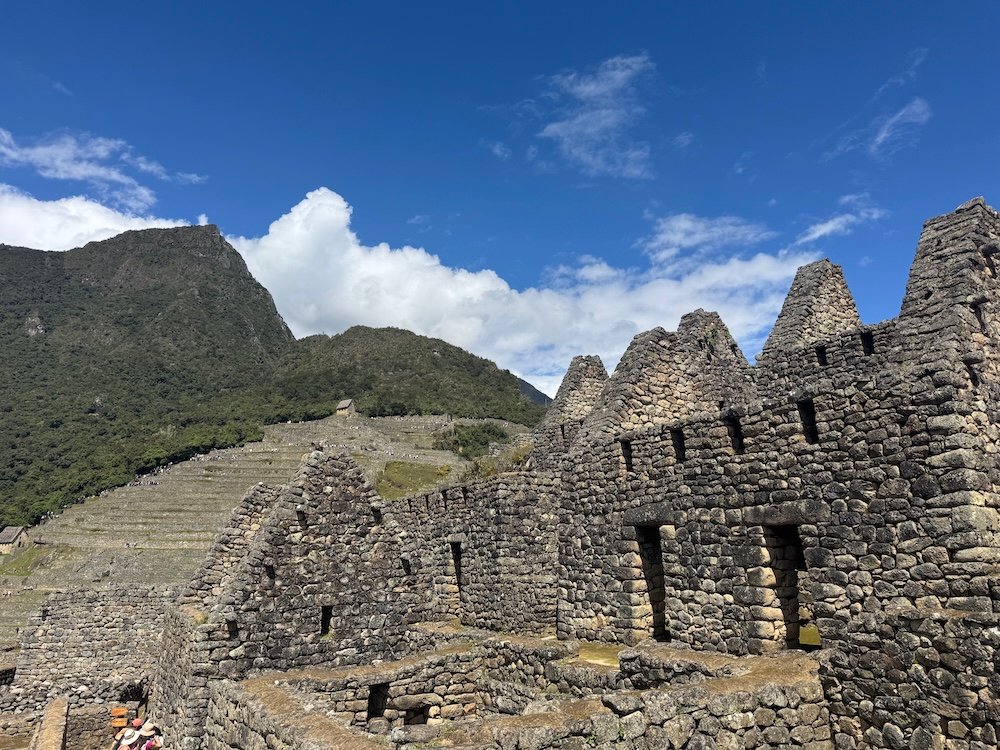
Along the way, we passed our first Inca site (though they’d become more spectacular the more we hiked) and finally reached our lunch spot near La Choza. By the time we had arrived, porters were already there and had set up our dining tent as well as air mattresses for us to relax on. No one was feeling tired at this point, but we still took advantage of everything that was given to us.
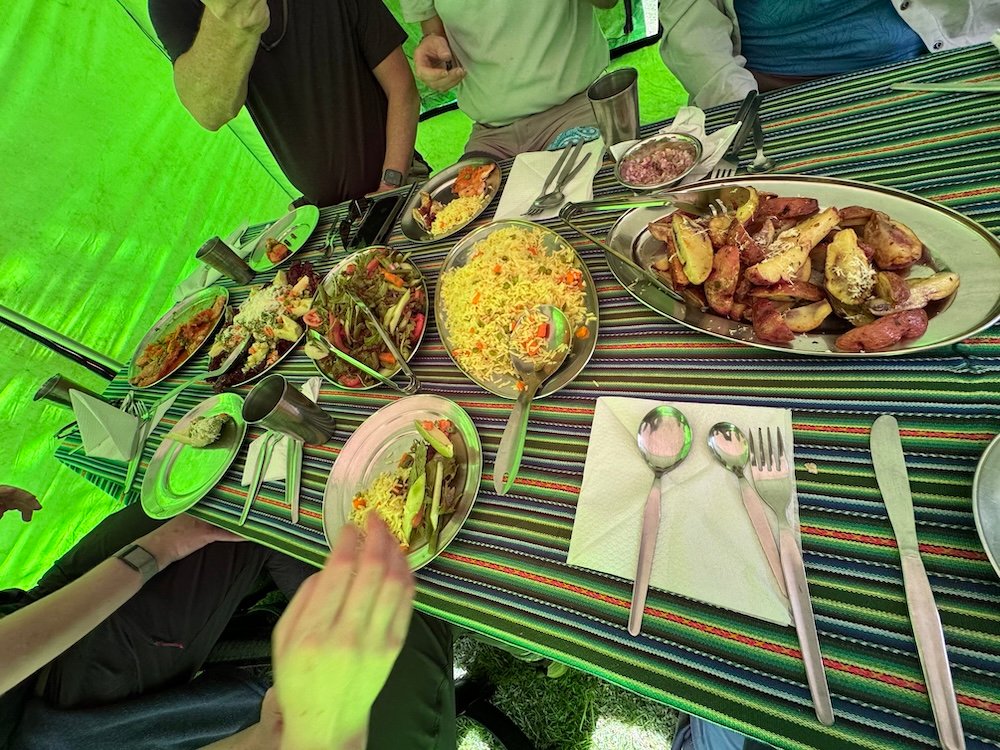
Lunch was delicious, just like every meal, but this was the first time we really saw what we could expect while on trail. Huge plates of trout, rice, avocado, salad, and potatoes were passed down the table. The food on the Inca Trail was better presented than some restaurants. How the chef (and sous chef) do all of this while hiking from camping spot to camping spot is nothing short of impressive.
After a long lunch, we packed up and started hiking again. It was another 3.5 miles to each our camping spot for the night at Wayllabamba. We continued our pattern of taking plenty of breaks, but since this afternoon included nearly 1,800 feet of elevation gain, no one was complaining. This is actually the very start of Dead Woman’s Pass. Anything we did today was less we would have to do tomorrow.
Somewhere along the way, we lost our main guide. After one of our first breaks in the morning, he disappeared and we didn’t see him again until dinner. I again had flashbacks to the Lost City Trek where our guides were constantly behind us because they were carrying a fully assembled museum display case up the mountain. That wasn’t the case here and Javi said it was just documentation that he was doing. I’m willing to bet that some of that documentation was related to my mess of an Inca Trail. But it’s what it was and he eventually made his way back to the group.
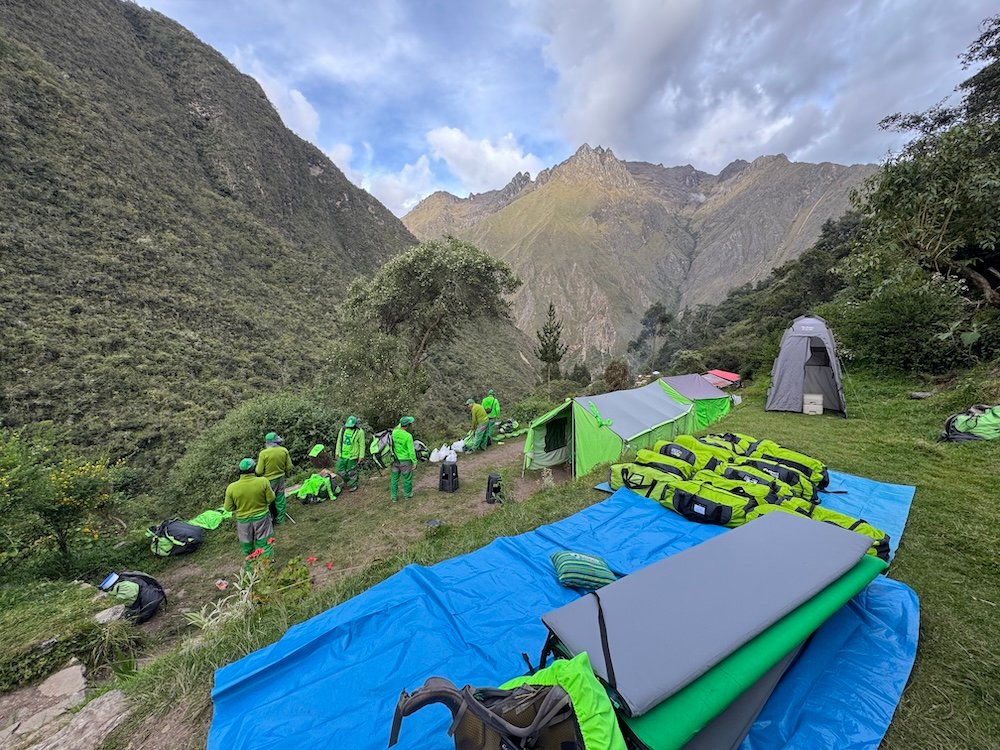
When we arrived into camp, we were assigned to our tents. I was too cheap to pay for a private tent, but was delighted when our group makeup dictated that I’d get a private tent. Woohoo! The tent felt downright spacious, though that meant that I didn’t have extra body heat in the tent to keep warm at night (and since I’m a very cold sleeper, that wasn’t ideal).
We unpacked for the night and were given a bowl of hot water to wash up. You can’t take a full shower, but it’s enough to wash your hands and face after a long day of hiking. Before we knew it, it was time for happy hour.
Happy Hour is a pre dinner snack. There’s no alcohol, but there are hot drinks, popcorn, and some kind of snack that changed everyday. Some nights was cheese wontons, one night was mini donuts, another night was crackers. We sat in the tent getting to know each other and snacking before five full plates of delicious food were brought out.
If all that wasn’t enough, our chef had a surprise for us. Dessert was banana flambeed in pisco. Yes. Our chef flambeed bananas in pisco table side for our dessert. If you’re wondering why it costs so much to hike the Inca Trail, this is part of the reason.
It was only 7:30 pm, but after dinner (and our briefing for the next day), we all got ready for bed and went to sleep. Between the early morning and hiking about eight miles through the mountains of Peru, we were all pretty tired.
Unfortunately most of us struggled on night one. It’s an adjustment to go from a bed to a sleeping bag on a narrow sleeping pad in a tent in the middle of the Peruvian mountains. Plus, our campsite was set up on angled ground. Most of us slid off our mattresses at some point during the night or got all tangled up inside the sleeping bag and sleeping bag liners provided. Other hikers complained about being really hot overnight, but me, in my sleeping bag, puffy coat, and hat, slept at just the right temperature.
We all did eventually fall asleep though. It wasn’t my most comfortable night of sleep, but I actually think I slept better on the Inca Trail than on the Lost City Trek. And I had an actual bed on the Lost City Trek.
What the Route Should Have Been: We stopped at Wayllabamba for the night, but if we were doing the traditional Alpaca Expeditions route, we would have kept hiking to Ayapata. This is another 0.9 miles and 500 feet of elevation further along the trail. While we were happy to get into camp, I don’t think it would have been too terrible to add in this last bit of hiking. At most, it would have added in one more hour of hiking.
Day Two – Dead Woman’s Pass
Normally on day 2, Alpaca Expeditions has you up early since this is supposed to be the toughest day of the hike. Normally, you’ll climb up and over Dead Woman’s Pass, stop for lunch, and then climb over Runkuracay before stopping for the night. Just thinking about it sounds exhausting.
Instead, my group had different campsites than the traditional route. Today we just had to focus on getting up and over Dead Woman’s Pass. Don’t get me wrong, this is still challenging, but I think it was much easier than it could have been.
While our day started at 5:00 am, this was actually the latest start we had during our entire Inca Trail Trek. We were greeted with a bowl of hot water and a cup of coca tea. We got dressed, packed up, and headed over for breakfast which was another delicious meal. There was not a bad meal on the entire trek and the chef gets a huge credit for that.
After breakfast, we took the time to get to meet our support team. Of course we already knew our guides, Javi and Walter, but we were introduced to the chef and sous chef as well as the 22 (yes 22!) porters who would be supporting us during this trek.
The chef has formal training, but all of the rest of the porters do this as a second job. Many of the porters are local farmers who work as porters on the Inca Trail during the farming offseason to support their families. Farming in Peru, like in so many other countries, doesn’t pay well, so this is what they do to make up the difference.
Not all porters are farmers, though. Some are students, working as porters to save money to pay for the university fees. My guide on the Ausangate 7 Lakes hike paid for his school by working as a porter for Alpaca Expeditions. He received his degree in tourism and is now a fully fledged tour guide. Javi has also met medical students studying math by flashlight after a long day of carrying gear up a mountain.
The bottom line is the porters are amazing and deserve so much credit for what they do. Tip them well at the end of the trip because there’s no way that you would have made it without them.
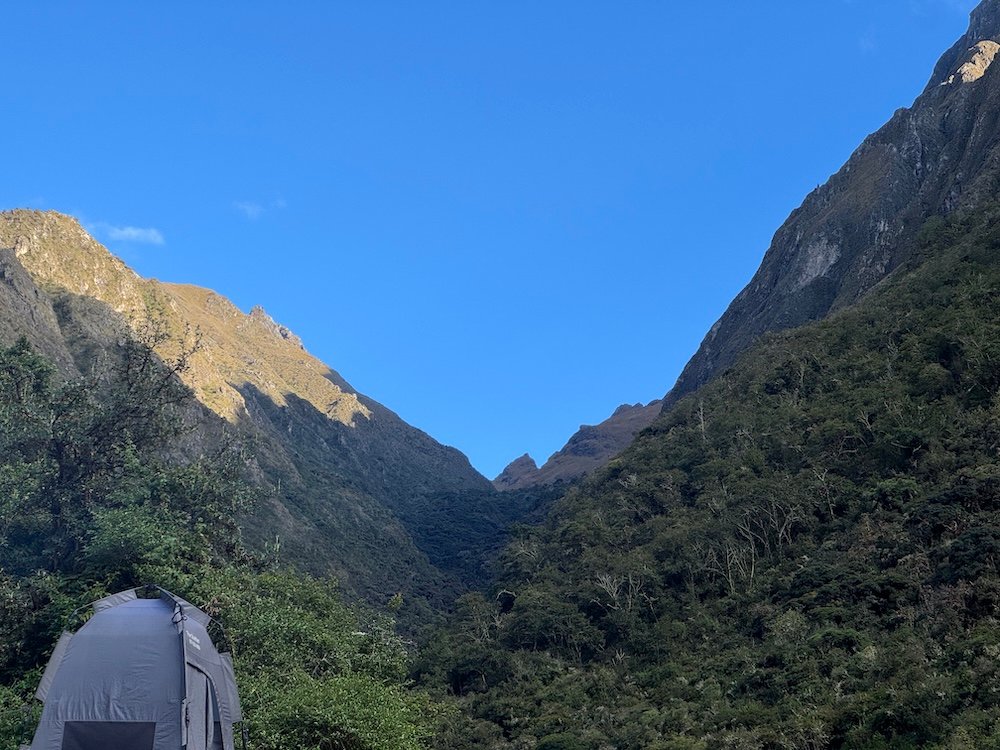
After our morning briefing, it was time to head out. We knew we’d be hiking up Dead Woman’s Pass, though we’d be stopping for lunch before reaching the top. Still, that meant our entire three hour morning hike was entirely uphill at high elevation. I’m not going to say it was fun, but we made it.
Prior to leaving our guide pointed out Dead Woman’s Pass. None of us could really see the face in the mountain, but we all were able to identify the mountain that looked like a nipple. For the rest of the day, our guides struggled to keep a straight face when we’d ask “so is the trail to the left or the right of the nipple”? It’s silly, but at least it kept us laughing during the hike.
As always, we took a lot of breaks along the way which helped to break up the hike. Not only did we take breaks, we also hiked incredibly slow. Based on my watch data, it’s difficult to tell which parts were hiking and which parts were breaks because we moved so slow as we trudged uphill.
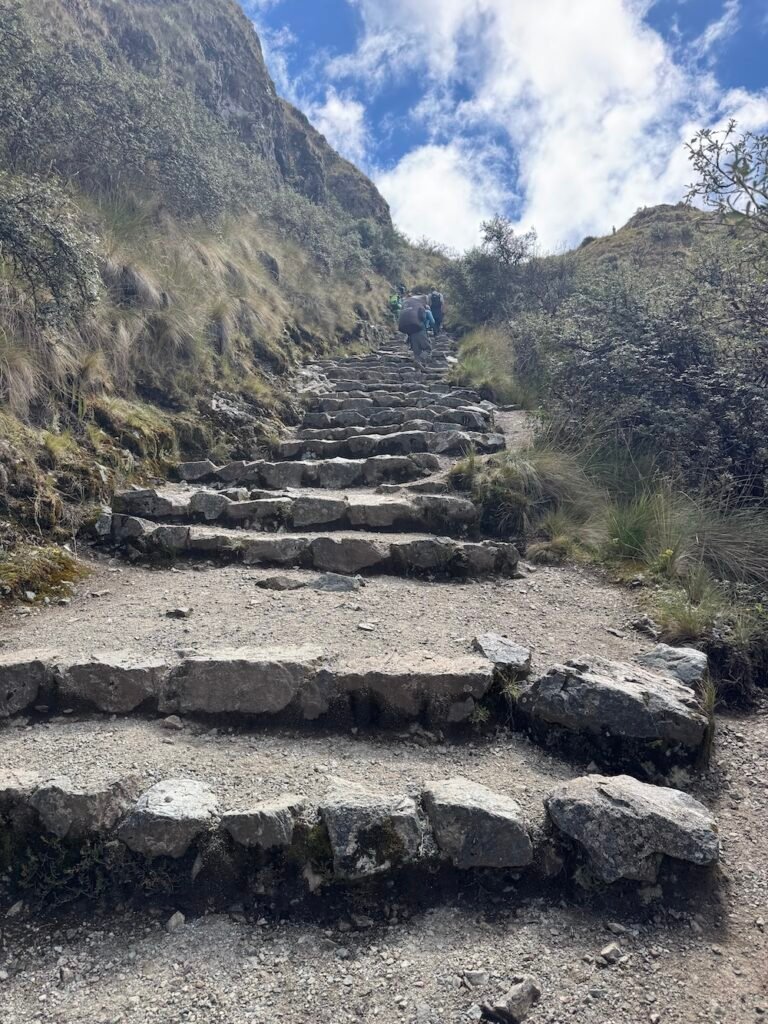
It’s not even a gradual uphill. Over 2.3 miles, we gained 2,000 feet of elevation. That’s nearly 1,000 feet per mile, so it was definitely steep and we were all thankful for our hiking poles. The biggest thing we learned is that you need to zigzag across the trail. The trail is still steep, but it’s a little easier if you zigzag across the steps. This is what the porters do and if they do this trail time and time again in a zigzag, they might be on to something.
Three hours after we started, we arrived at Llulluchampa, which was our lunch spot for the day. We relaxed on the air mattresses that were already set up and tried not to think about how we still had more climbing to do. Lunch was once again delicious, though some people were starting to lose their appetites because of the altitude. Since I had spent nearly a month at high altitudes before doing the Inca Trail, I felt fine and didn’t have any symptoms of altitude sickness. I did move slower at higher elevations, but I think everyone did too.
This lunch also helped to bond our group. Just before camp, there was an informational sign about Llulluchampa. One guy went back to take a picture. It was a less than five minute uphill hike to camp, so it should have taken him no time at all to go down and come back.
Well, nearly 20 minutes later, he wasn’t back and we started to get worried (though not enough to push back the start of lunch). He finally returned 30 minutes after he originally left. Apparently he missed the sign and walked way further than he needed to. To make matters worse, it turns out he had already taken a picture of the sign on our initial hike passed it.
For the rest of the trip, any time we passed a sign, we made sure to point it out and remind him. Signs became a running joke in our group. He took it in stride and joined in on the jokes himself. It’s the little things like this that help to bond your group and make the trek actually enjoyable.
Everyone had some defining characteristic that we poked fun at. Matt was his backtrack for the signs. John brought his own camp chair as a luxury item (to the envy of all of us). Every time someone needed the butter at breakfast, people looked to me first as if I would be hogging it (since apparently all we eat in Wisconsin is butter… there’s probably some truth to that). Kat had the most random facts every day.
Honestly, after the Colca Canyon where I didn’t bond with anyone, it just felt good to have a group that all got along.
Lunch was over and we finally had to start that climb to the very top of Dead Woman’s Pass. No one was looking forward to it, but it had to be done. For this section, we’d all go at our own pace and we’d meet at the top of the pass. Our guides estimated two hours.
So, we slowly headed out and the group broke up pretty quickly as everyone found their own rhythm of one foot in front of the other. The air was thin, the route was steep, and it’s just not a fun section of trail. If climbing up to Dead Woman’s Pass wasn’t bad enough, the last section right before the top is helpfully named the “Gringo Killer” stairs. They are steep, but honestly, I think we had steeper stairs later in the trail.
An hour and 25 minutes after leaving lunch, I arrived at the top of Dead Woman’s Pass and was greeted by a round of applause. It’s the highest point on the trail (and the hardest section), so everyone celebrates the next person making it to the top. It’s a great morale booster after a tough climb.
I was number 6 of 12 to arrive and was shocked. I’m typically the last to arrive on the uphill sections during group hikes, so I felt amazing. I sat down to enjoy a package of sour gummy worms that I’d been saving as a reward for this tough section of trail. I then joined the cheering section to welcome the rest of our group as they made it to the top.
We also cheered on our porters. I don’t know if every group does this, but I definitely saw a lot of smiles on the porters’ faces as they came over the top of the mountain and got applause from their hiking group. So my advice? Applaud your porters because they are doing the same trail you are, but with 25 kilograms worth of stuff strapped to their backs.
As we waited for more hikers, we started chatting. I was feeling so proud of myself that I hiked this last section in under and hour and a half. That’s a full 30 minutes faster than what the guides suggested.
Then I heard that John, someone who is in the active military, finished in under an hour. How he went that fast, I’ll never know. It’s impressive, sure, but also insane and we poked fun of him the rest of the trip for his speed. That said, he decided it was no fun being first and waiting for everyone so he slowed down his pace drastically after this (even though he was still one of the first people to finish the hikes).
Just over two hours after we departed, the last hiker in our group crested over the top of Dead Woman’s Pass. Everyone in our group officially made it to the top, including the 70 year old. We took a group photo shouting “Never Again!” instead of “cheese!”.
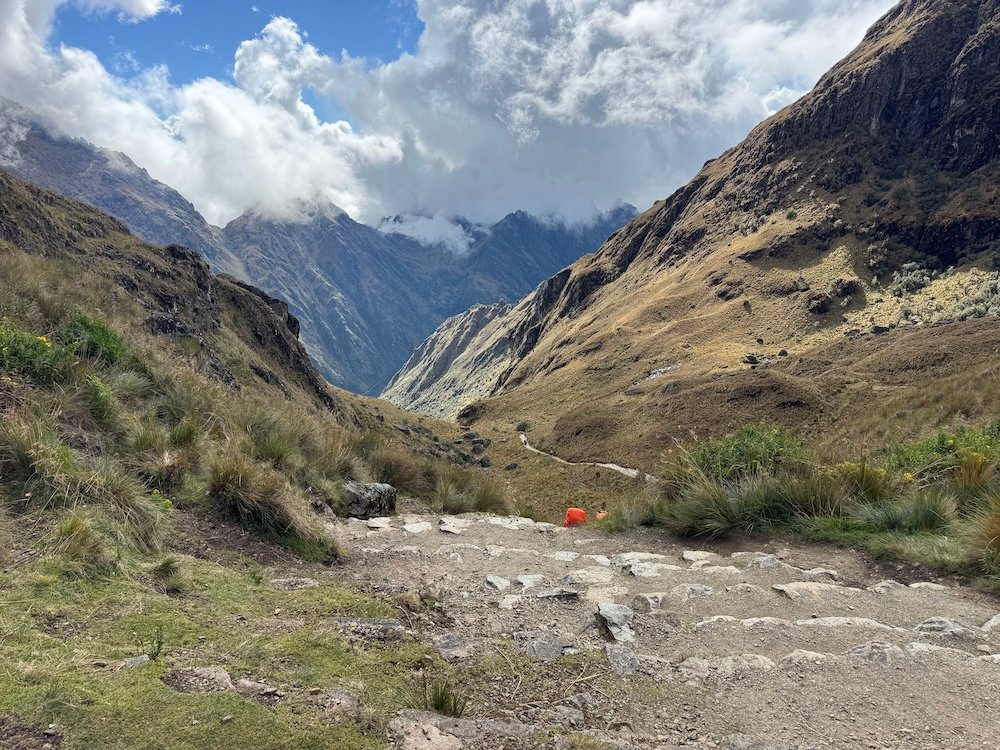
From here, we just had to descend into camp. It’s 1.5 miles, but it’s all downhill. Unfortunately, Dead Woman’s Pass is just as steep on the descent as it is on the ascent. But at least we weren’t struggling to breathe as we hiked downhill.
Our guides told us that we’d eventually hear a waterfall and once we heard that it was twenty minutes to camp. We heard a waterfall early on and got excited that we were almost there. False alarm. Apparently they were referring to the second waterfall. That was unfortunate because we were all pretty tired at this point. Five hours of hiking uphill to the highest point on the trail and we were all just ready to be done.
We arrived into camp tired and exhausted, but thrilled that we only did one mountain pass today. On a typical Alpaca Expeditions route, there’d be a second mountain pass after this. Sure you’d have hiked a bit further on day 1, but even still, that’s a tough hike and we were happy to push it to tomorrow.
It was another early night. We went to happy hour, ate dinner, and were in bed by 7:30. It also didn’t help that it was much colder up here so despite wearing all of our warmest clothes to dinner, no one really wanted to sit out. We all wanted to crawl into our sleeping bags, warm up, and go to sleep. It’d be another big day tomorrow.
Thankfully though, our camp was more flat this time and we learned from last night. I got less tangled in my sleeping bag and didn’t keep sliding off the mat. That’s progress.
What the Route Should Have Been: We should have started from Ayapata, which would have eliminated the first hour of our day. We still would have climbed up and over Dead Woman’s Pass. However, where we stopped for camp at night would have been our lunch spot and after lunch it would have been another three hours of hiking up and over Runkuracay Pass.
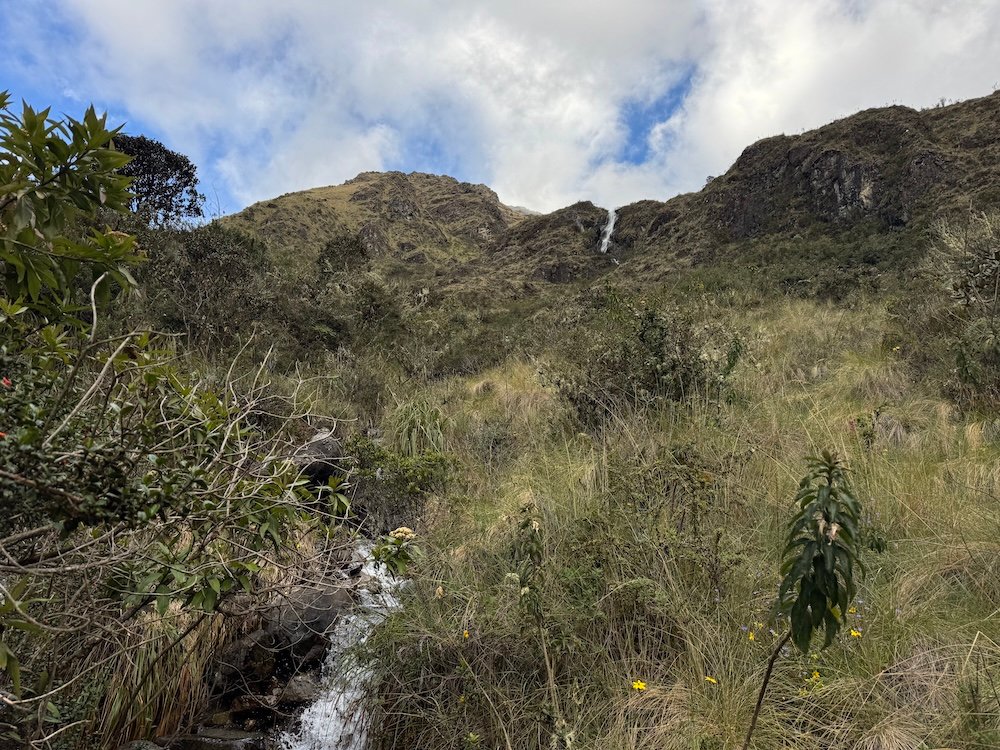
Day Three – The Long Day
Most Alpaca Expeditions treks get a break on day 3. The hardest part of the trail is behind them and now they just have a short bit of distance to cover. Not us. We still had to do one more mountain pass, plus a ton of downhill to get to our campsite for the night. So, we were up at 4:30 am. We got ready, packed up, ate breakfast, and then we were on our way. It was early, but at least we didn’t need headlamps once we left camp.
Today was our long day and it started with a climb up and over another mountain pass. This time, we’d be climbing Runkuracay Pass and while it sits at 13,000 feet above sea level, it gets way less recognition than Dead Woman’s Pass. I think it’s because everyone just worries about Dead Woman’s Pass because it’s first and it’s higher. But Runkuracay Pass isn’t easy either.
We trudged up another mountain pass, knowing that this was the last big climb of the Inca Trail. We knew we’d still have some more uphill, but this was the last major climb. We just had to get to the top. Like Dead Woman’s Pass yesterday, we were able to go at our own pace. Like yesterday, I also finished in the middle of the group, so I was still feeling pretty strong.
Shortly after arriving to the top of Runkuracay Pass, our assistant guide came up behind us. He asked us if we wanted to see a “spectacular bird”. Not being a birder, I declined and opted to eat a snack while the people who arrived before me followed Walter up the mountain. After finishing my snack, the group still wasn’t back so I decided to follow. I may not be into birds, but if they were still watching this bird, it must be good. Plus, I had remembered that Javi had said if we hiked another five minutes uphill, we’d get a great view.
Halfway up, I still couldn’t see them and all I could think was “this must be the coolest freaking bird ever.” When I arrived they shushed me (not that I was making any noise aside from my footsteps). We weren’t watching a bird. We were watching a mama bear and her cub play on the other side of the valley.
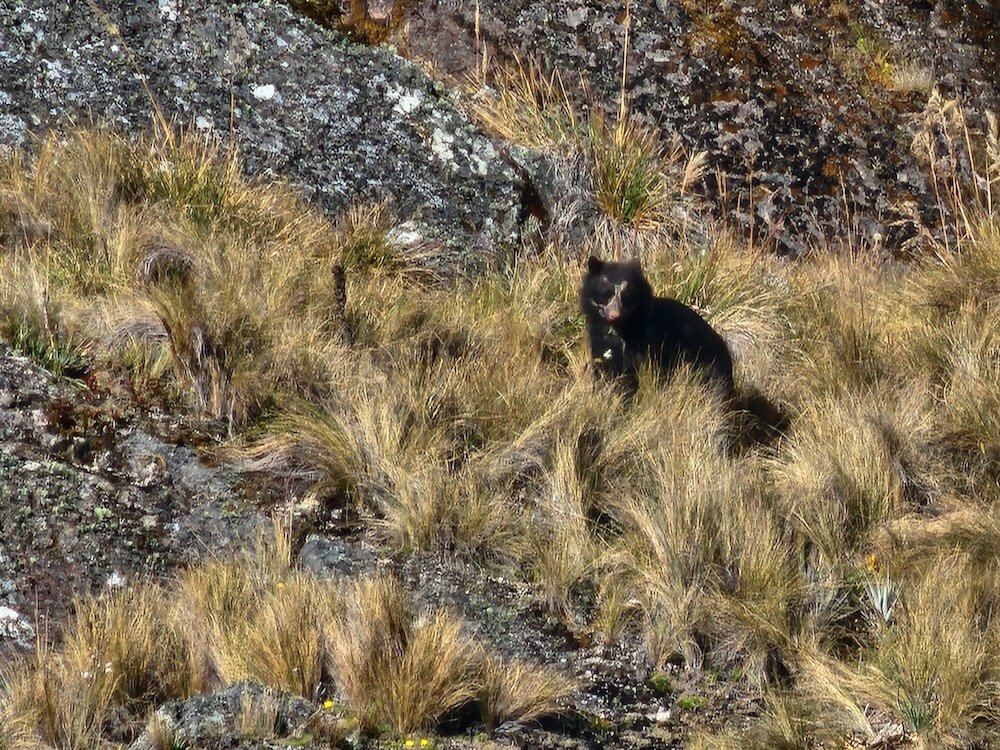
Bears are one of the animals you can see on the Inca Trail, but it’s rare. Our guide, Javi, said this was only the fifth time he’s seen this bear and he hikes the Inca Trail once a week. So we definitely got lucky. A huge shout out to Kat for spotting what she thought was a dog on the mountain. Javi and Walter realized it was a bear and Javi sent Walter running up the mountain (much to his displeasure) to get those of us who had already made it to the top of the pass.
And before you ask, no. I was not only one who heard Walter ask for a “bird” instead of a “bear”.
We spent a bit longer than anticipated at Runkuracay Pass, but given that we saw a bear, I think that’s pretty understandable. From here, we hiked back down the mountain, stopping at Sayaqmarka along the way. We passed some Inca sites on day 1, but nothing on day 2. Day 3 would make up for it as we stopped to learn some more history about the Inca people. Then, it was back to hiking.
In total, our morning hike lasted six and a half hours. We covered 5.4 miles and gained over 2,000 feet of elevation (and lost 1,900 more feet). Needless to say we were ready for a break when we finally arrived at lunch.
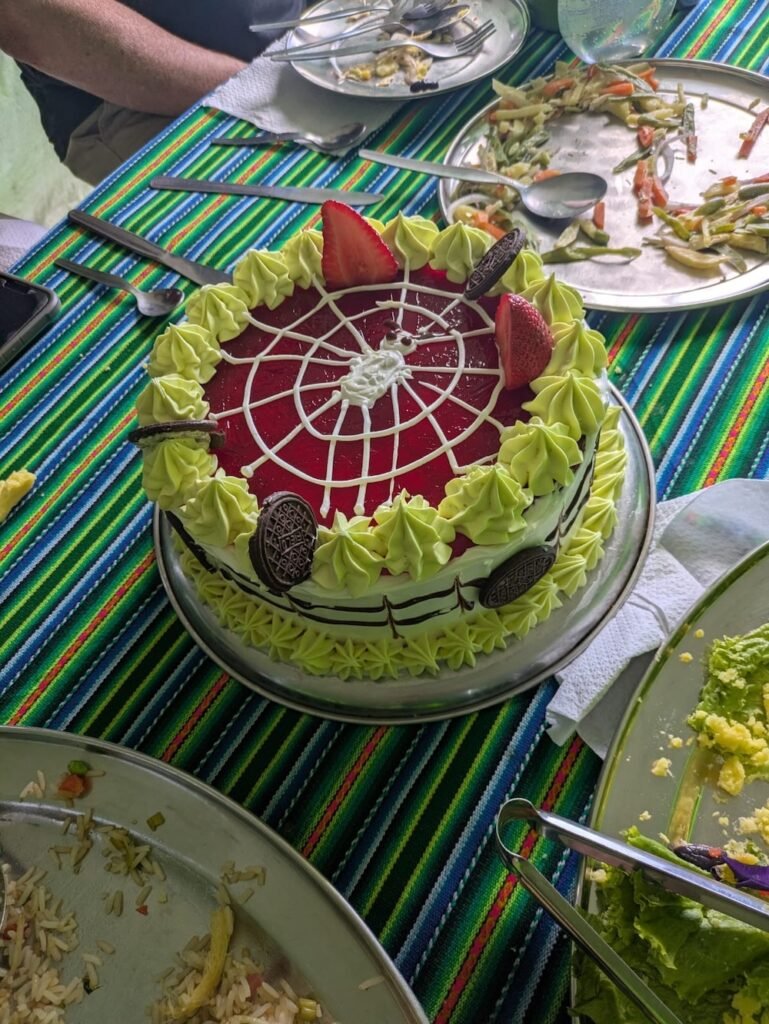
Not only was lunch delicious, but we were surprised by the chef again. Banana flambeed in pisco for dessert on night 1 was impressive, but at lunch on day 3 he brought out a cake. Yes, a cake. We have no idea how he baked it because there are no permanent campsites and the porters carry everything for our group down the trail. So again, shout out to our chef for making a more beautiful cake in the rural mountains of Peru than I can make in a fully stocked kitchen.
After lunch it was more and more and more downhill hiking. The good news is that we could breathe again as we descended. The bad news is that it felt like the descent was never going to end. Over 3.5 miles, we’d descend 3,200 feet. That’s a lot of elevation change in a short amount of time. Though it was cool once we arrived at our campsite for the night and we were able to look up and see just how far we descended.
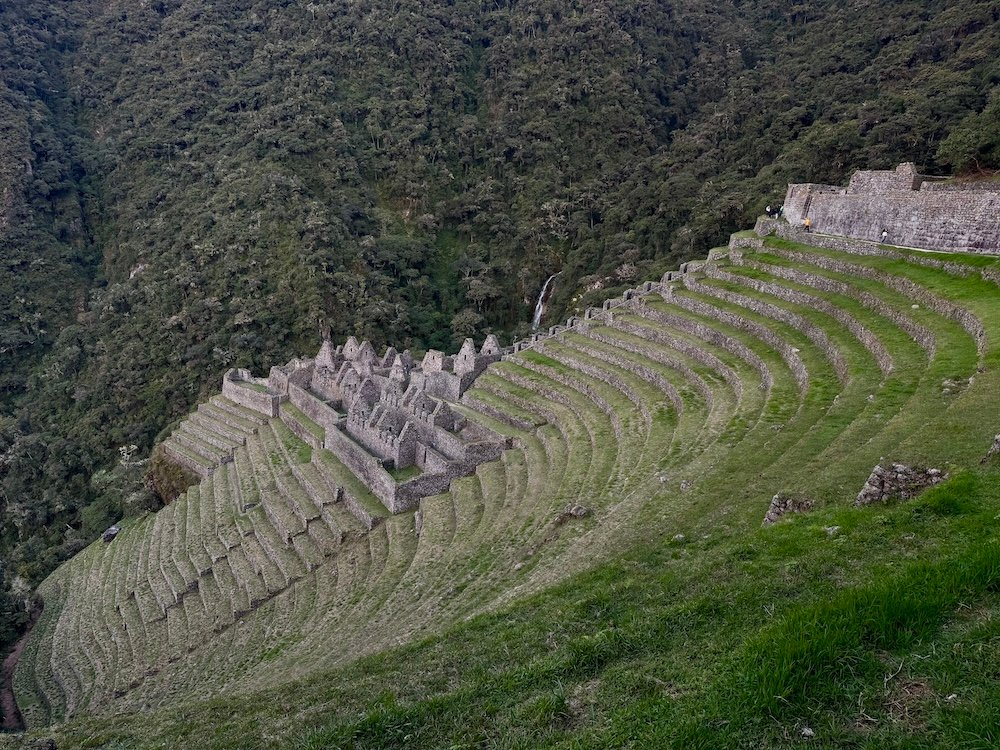
Even though we arrived at camp, we weren’t done hiking. We dropped off our packs and hiking poles and followed our guide for one more Inca site. Wiñay Huayna is a one mile round trip from our campsite (and it’s as close to gringo flat as the Inca Trail can get). This was impressive and we got one more history lesson before our hike into Machu Picchu the next day.
Day 3 was our longest day and by the time we returned from Wiñay Huayna, we only had a a few minutes before happy hour was ready. After dinner, we were all exhausted. Yes, we were excited about Machu Picchu the next day, but we were tired from three days of hiking. Dinner was bittersweet as we knew that it was the last dinner we’d all share together.
We pooled our money and gave some much deserved tips to our chef and porters before saying good night and crawling into bed.
As a note, we could tell we were at lower elevations. I’m a notoriously cold sleeper and spent the first two nights in my puffy coat as well as my sleeping bag. The first night, most people in my group said they were too hot. I was comfortable. That third night was warm and I was trying to get out of my sleeping bag to cool down (as was everyone else). So, be prepared for all temperatures on the Inca Trail.
What the Route Should Have Been: Had we followed the traditional route, today would have been easy. We would have already done Runkuracay Pass yesterday and would have started the day at Choquiocha. We still would have finished in the same place, so it would have been a lot less hiking (though day 2 would have had a lot more).
Day Four – Arrival in Machu Picchu
On our last day, we got up at 3:30 am. It was early and we were tired, but in just a few hours, we’d be standing in Machu Picchu! Unfortunately that’s not as easy as it sounds.
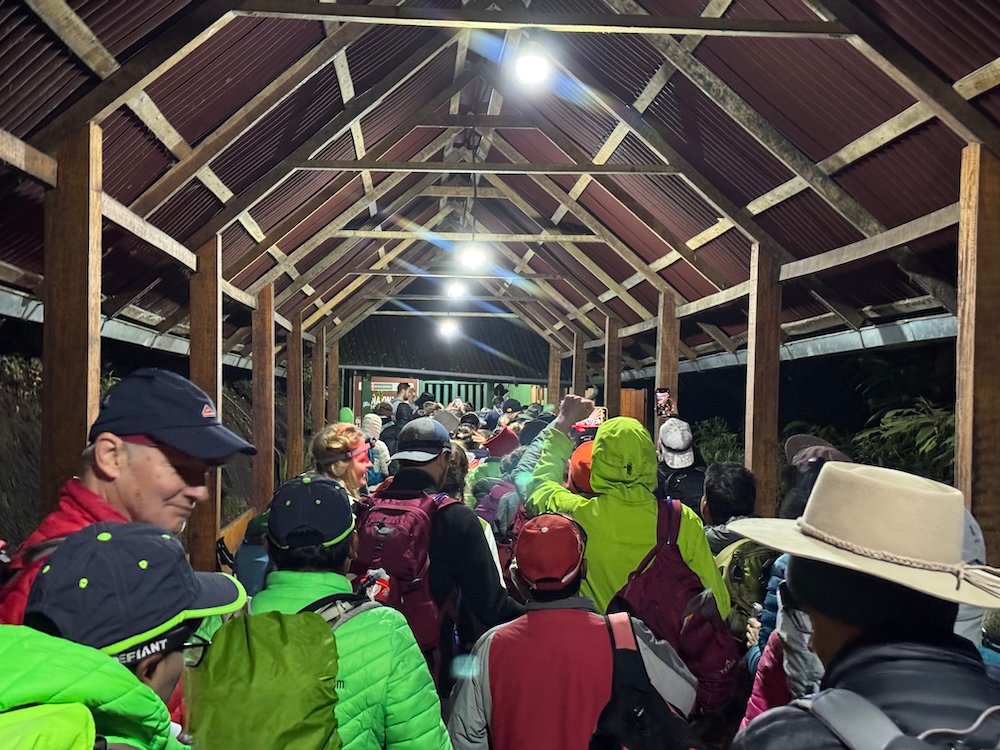
We packed up and had some hot drinks (unfortunately for me, we finished the hot chocolate mix the night before and I don’t drink coffee or tea). We grabbed a bag lunch and walked five minutes down the trail to a checkpoint. Unfortunately we weren’t the first group, so all of the benches were taken. So, we pulled out our rain ponchos (the only use they’d get over the four day trek) and sat on the ground for an hour and a half waiting for the check point to open at 5:30 am.
This sounds absolutely ridiculous, but there’s a few reasons for this.
First is that we want the porters to be able to get an early start. Their train from Aguas Calientes leaves at 5:00 am and if they miss it, they have to wait until 6:00 pm. After all they’ve done for us the last few days, the least we can do is try to let them get home earlier.
Second, the check point doesn’t open until 5:30 am because the government doesn’t want people hiking this section in the dark. It’s narrow and rocky and people are in a hurry to get to Machu Picchu. That’s a recipe for disaster.
Third, even though we weren’t the first group in line, your goal is to be the first group in line. The earlier you are in the line, the faster you can get to Machu Picchu. The faster you get to Machu Picchu, the longer you have at the Sun Gate before other hikers show up.
So, we arrived just after 4:00 am and sat on our ponchos eating chicken salad sandwiches in the dark. Not quite what you picture when you think of hiking the Inca Trail.
But finally the sun came up, the checkpoint opened, and people started being allowed through. At the advice of Javi, we shed one layer before starting our hike.
Our group had a good pace for the last three days, but this morning we were on a mission and Javi led us at a much faster pace than he had for the last three days. All of us noticed it. The good news is that it was Peruvian Flat and we could all keep up, but we could feel that we were moving faster.
After one mile, we stopped so everyone could strip off another layer. It’s amazing how fast it warms up. Though it probably also helps that we were hiking as fast as we could. Then, it was just one more mile until we reached the Sun Gate.
Even though this is the shortest day of the trek, and the day we were most excited for, it doesn’t mean the entire day is easy. It wouldn’t be a section of the Inca Trail without one more set of “Gringo Killer” steps. These are steep and I believe these were the steepest steps we encountered. Almost all of us used our hands as we climbed these steps as if they were a ladder.
However, as we got to the top, we could see Inca ruins in the distance. We were almost there.
Finally, after more than three days of hiking, we arrived at the Sun Gate. We crossed through, looked down, and there was that iconic view of Machu Picchu. Prior to my trip, I avoided photos of Machu Picchu, wanting to experience it with an open mind. Let me tell you that was the right decision. It looks magnificent from up here, and knowing how hard you worked over the last three days? That just makes it even better.
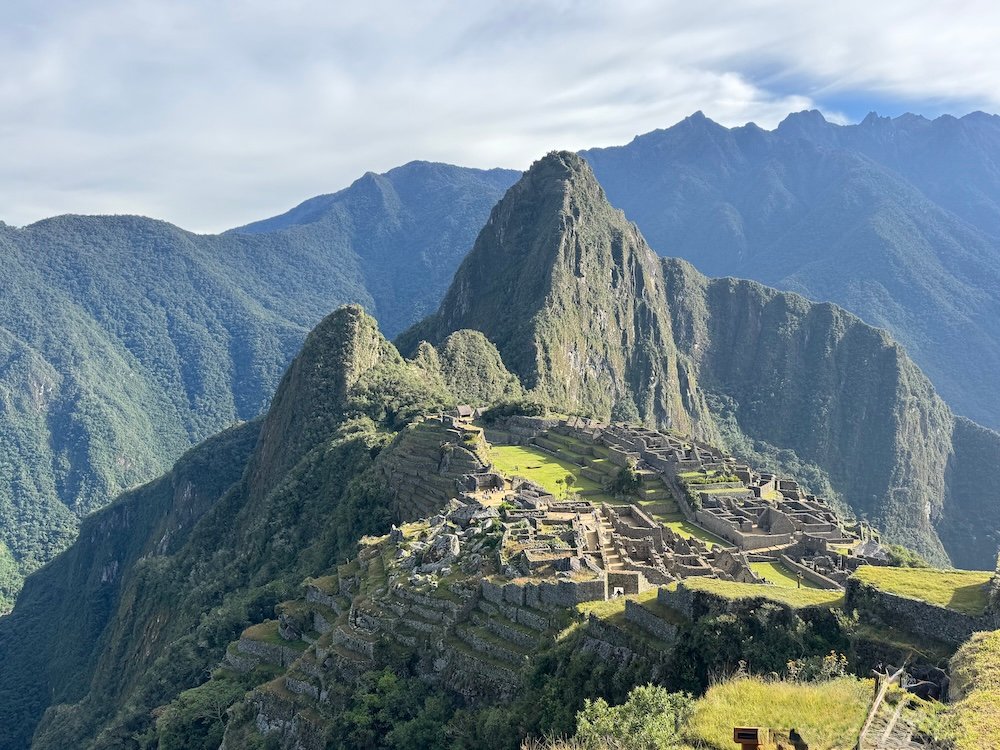
We took our photos and sat and enjoyed the view. I’ve eaten a lot of Oreos during my travels, but I think this might have been the most scenic spot I’ve ever eaten a pack. Yes I had fruit in my backpack, but Oreos felt way more celebratory. We all made it!
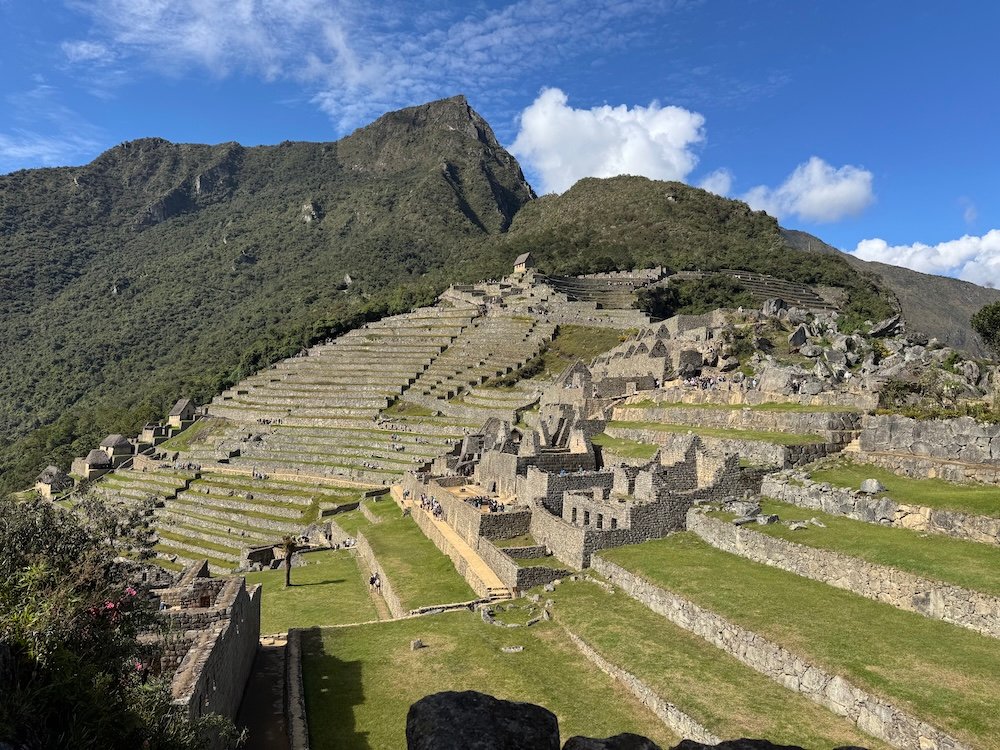
Eventually we had to keep moving, so we followed Javi down the trail and into the main Machu Picchu complex. We joined Circuit 1 and it was a bit of a shock to the system. Regular tourists, who hadn’t just hiked for four days, were also here enjoying the view. After the last few days, it was crazy seeing all of these people in one place. But everyone should be able to enjoy the view.
While I waited to get my photos of the iconic postcard view of Machu Picchu, I thought back to the Lost City in Colombia. The only way to visit the Lost City is by hiking, whereas here in Machu Picchu you could hike or take the bus in. There was something incredibly special at the Lost City knowing that everyone who was here had worked hard for it. That’s not to disparage the people who didn’t hike, but I do believe you see Machu Picchu with slightly different eyes if you’ve hiked through the mountains of Peru for several days.
A few more stops for photos and we completed Circuit 1 and exited Machu Picchu. Javi turned to proclaim to us that the section we were on was “Gringo Flat”. It felt amazing. It was actually flat and paved and so smooth. Luxurious!
After the Trek
Here’s where things started to get very chaotic for me. For most people, things continue to flow smoothly, but I was in a messy situation.
I had originally booked a 5 day/4 night trek. On that itinerary, we’d enter Machu Picchu in the afternoon and follow Circuit 1. Instead, I had done that early in the morning and finished by 8:30 am.
The rest of my group went back into Machu Picchu to get their tour of Circuit 3, but my permit for was for the next day (since that’s how my 5 day tour was set up). So I couldn’t follow them, which was a huge bummer.
Instead, I took the bus to Aguas Calientes by myself. It was a very weird experience because I knew that the rest of my group was all still together. I just wasn’t allowed to come with.
Also, unsurprisingly, no one wanted to sit by me on the bus (it was early in the day and not full) and I can’t imagine why. Who wouldn’t want to sit next to someone who hadn’t showered in four days (and had hiked over 25 miles during that time)?
In Aguas Calientes, I went to the restaurant where my guide told me I’d find my luggage. Then, I walked to the hotel that I had booked for the night. In a typical 5 day/4 night Inca Trail trek, Alpaca Expeditions takes care of the hotel. Since I was alone, I convinced them to refund the room and let me book it myself, which allowed me to save about $25.
Unsurprisingly, the room wasn’t ready at 9:45 in the morning. So I dropped my bag and headed out again. There was a waterfall nearby my hotel, so I started with a walk there. Apparently I hadn’t had enough hiking over the last few days.
I didn’t go all the way to the waterfall since I was too cheap to pay the entrance fee. But I did manage to see a cock-on-the-rock (yes, that’s a real bird name), which is the national bird of Peru. I took a picture to show the birdwatchers in my hiking group. They may have toured Machu Picchu, but I saw a cool bird.
I also walked around the market in Aguas Calientes and bought an Inca Trail sticker. But the highlight was when my room was ready and I was finally able to take a shower. I didn’t have my shampoo, conditioner, or a razor, but I’d still rate it as one of the best showers I’ve ever had.
After, I met my group for lunch. They had finished their Machu Picchu Tour and had made it to Aguas Calientes. I may not have gotten to tour Machu Picchu (yet!) but I got to take a shower, so who was really winning? Plus, I showed off my bird picture, much to the jealousy of a few group members. We enjoyed lunch, spent a little more time in Aguas Calientes and then they all boarded the train back to Ollantaytambo where a van would bring them back to Cusco.
Meanwhile, I stayed in Aguas Calientes, waiting until I’d be able to visit Machu Picchu. There’s not a lot to do in Aguas Calientes. It’s a town that mostly exists as a gateway to Machu Picchu. There’s hotels, restaurants, and shops. And that’s about it. So I spent my afternoon and evening reading on my Kindle and scrolling through my phone. I did return to the same restaurant for dinner (Alpaca Expeditions was covering my meals thanks to the mix up and I treated myself).
Here’s where I really started to get frustrated. It was nearly 7:00 pm and I still didn’t know what the plan was for tomorrow. I was supposed to have a guided tour of Machu Picchu, but I had no idea where or when to meet the guide. When the trip changes were initially explained to me, I was told I’d join up with the next group who finished the 4 day/3 night Inca Trail. My guide told me that he thought I’d be joining people who did the 2 day/1 night Inca Trail. In actuality, I joined people who finished the Salkantay Trek.
But at 7:00 pm, I was still trying to figure out where and when I needed to meet. I finally received an answer after badgering two different two guides, but considering I requested this information before my trip, this was more than a little annoying.
Day 5 – Machu Picchu and Huayna Picchu
I met my new guide the next morning at 5:50 am. He came to my hotel and walked me to the bus stop which already had a big line. Thankfully, the line moves quickly. However, much to my annoyance, this guide didn’t know if he was going to be my guide or not. This lack of organization was really getting on my nerves and I typed up a strongly worded (but respectful) email to Alpaca Expeditions expressing my frustrations with this chaos.
I boarded the bus and made the ride back up the mountain to the Machu Picchu entrance. Here I joined a group of three who had just finished the Salkantay Trek. We would be getting a tour of Circuit 3 together.
So after all the frustration and stress, how was the tour? Honestly, not great. You can’t love every tour guide you ever get and the guide I was assigned to just didn’t do it for me. A lot of the information was things I had already covered on my 4 day hike and the guide seemed to repeat himself a lot. He was very knowledgeable, but he just wasn’t very engaging.
All four of us had tickets for Huayna Picchu, with varying times between 9:00 and 10:00, so we think he was just trying to stall long enough for our tickets. He did manage to stall, but he also managed to bore me in the process. I had hoped to get a guide who could help bring these ruins to life. I did learn a little bit about some of the structures, but it was nothing like I had hoped. At 9:30, when we arrived at the start of the hike to Huayna Picchu, I was relieved.
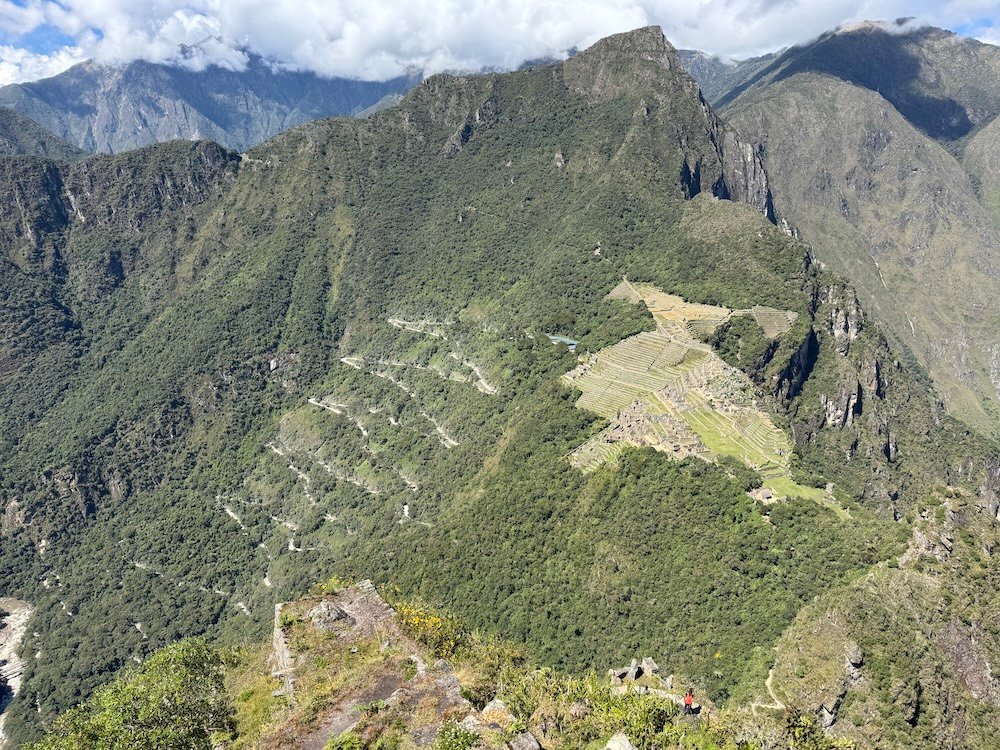
Huayna Picchu is the tall mountain that you’ll see in the background of any photo of Machu Picchu. In order to climb this mountain, you must have a special permit and I picked mine up when I paid for my Inca Trail experience, not truly realizing what I had signed up for.
On my 4 day hike, there was a lot of discussion about Huayna Picchu. Five other people in my group had signed up, but in the end, four backed out. Exhaustion played a big role, but it was a whole lot different saying “I’ll hike it” when making your reservation than when you’re standing in front of the mountain.
In the end, three people ended up hiking it (two people gave their tickets to other group members who wanted to hike—with their passports since passports are checked against tickets). They told me it was tough, but they managed to hike up in 35 minutes and back down in 25 minutes. Javi had told us 45 minutes each way and my guide on day 5 said 2 hours round trip.
The hike was tough, but doable and I did it in an hour and 45 minutes, including all of the time spent stopping for pictures and to catch my breath. It was a fantastic view and a great way to end my Machu Picchu experience. I may have had a lot of issues, but at least I was ending Machu Picchu on a high note.
I followed Circuit 3 to the exit of Machu Picchu, snapping a few last photos along the way. Then it was back on the bus and back to Aguas Calientes. I was feeling a bit let down from the Machu Picchu tour so I went to a bakery and got a slice of cake for lunch to make me feel better. I also sent my email to Alpaca Expeditions while I waited for my train to depart.
At 3:30, my train finally pulled out of Aguas Calientes station and two hours later, I was back in Ollantaytambo. Here was more confusion as I had to try to find the right driver. All of the other Alpaca Expeditions groups regroup here in Ollantaytambo, but my main group went through here yesterday. I’m still not sure if I was in the right van, but I ended up in an Alpaca Expeditions van bound for Cusco.
On the way back, I got a message on WhatsApp from Alpaca Expeditions wanting to talk about my email. That was the fastest response I ever received from them (and we had a lot of communication in the week leading up to my departure). We would connect the next day and agree on a partial refund for all of the headaches, stress, and anxiety of the last few days. So while I definitely had a messy trip, I have to give credit for Alpaca Expeditions for trying to do what was right.
Back in Cusco, I was put in a taxi and was dropped off at my hotel. My trip was officially over and I was exhausted.
Inca Trail Stats
Now that you’ve read all about my experience on the Inca Trail, here’s some stats to show how things actually break down.
By Section
| Section | Description | Distance | Elevation Gain | Elevation Loss | Highest Point |
| Day 1 – Morning | Kilometer 82 to La Choza | 4.7 miles (7.5 kilometers) | 837 feet (255 meters) | 764 feet (233 meters) | 9,208 feet (2,806 meters) |
| Day 1 – Afternoon | La Choza to Wayllabamba | 3.5 miles (5.6 kilometers) | 1,768 feet (539 meters) | 135 feet (41 meters) | 10,445 feet (3,184 meters) |
| Day 2 – Morning | Wayllabamba to Llulluchapampa | 2.3 miles (3.7 kilometers) | 2,037 feet (621 meters) | 49 feet (15 meters) | 12,400 feet (3,880 meters) |
| Day 2 – Afternoon | Llulluchapampa to Runkuracay | 3 miles (4.8 kilometers) | 1,473 feet (449 meters) | 2,037 feet (621 meters) | 13,902 feet (4,237 meters) |
| Day 3 – Morning | Runkuracay to Phuyupatamarca | 5.4 miles (8.7 kilometers) | 2,106 feet (642 meters) | 1,952 feet (595 meters) | 13,121 feet (3,999 meters) |
| Day 3 – Afternoon | Phuyupatamarca to Wiñay Huayna | 3.5 miles (5.6 kilometers) | 33 feet (10 meters) | 3,205 feet (977 meters) | 12,076 feet (3,681 meters) |
| Day 4 | Wiñay Huayna to Aguas Calientes | 3.6 miles (5.8 kilometers) | 594 feet (181 meters) | 1,372 feet (418 meters) | 8,938 feet (2,724 meters) |
By Day
| Day | Distance | Elevation Gain | Elevation Loss | Highest Point |
| 1 | 8.2 miles (13.2 kilometers) | 2,605 feet (794 meters) | 899 feet (274 meters) | 10,445 feet (3,184 meters) |
| 2 | 5.3 miles (8.5 kilometers) | 3,510 feet (1,070 meters) | 2,086 feet (636 meters) | 13,902 feet (4,237 meters) |
| 3 | 8.9 miles (14.3 kilometers) | 2,139 feet (652 meters) | 5,157 feet (1,572 meters) | 13,121 feet (3,999 meters) |
| 4 | 3.6 miles (5.8 kilometers) | 594 feet (181 meters) | 1,372 feet (418 meters) | 8,938 feet (2,724 meters) |
Total
Distance: 26 miles
Elevation Gain: 8,848 feet
Elevation Loss: 9,514 feet
Total Hiking Time: 25 hours
Important Notes About the Inca Trail
Now you’ve heard about my experience. Here’s what you need to know about the Inca Trail for your own adventure.
You Must Book Early – The Inca Trail has limited availability for hikers and permits usually sell out six months in advance. If you want to hike the Inca Trail, plan ahead and book early. I think this is a big reason why the Salkantay Trek has risen in popularity, especially with backpackers. The Salkantay Trek does not sell out as quickly (though it still needs to be booked in advance).
The Inca Trail is the Only Way to Visit the Sun Gate – If you hike one of the alternative treks, like the Salkantay or the Lares Treks, you will end in Aguas Calientes and you’ll take the bus to Machu Picchu. The only way to visit the Sun Gate is to hike in on the Inca Trail.
Your Porters Have Limits – It can be tempting to bring luxuries, but you really need to pair your things down. Your porters will carry a lot of your things, but they are limited to how much they can carry. In order to meet these requirements, Alpaca Expeditions limits you to just 7 kilograms. When you factor in the weight of the provided pillow and their rented sleeping bag, that brings you down to just 4 kilograms. Anything more than that you need to carry in your day pack or leave back in Cusco.
You Must Go With a Group – It is not possible to hike the Inca Trail on your own. You must go with a group. There are permit checks along the way and you will not be able to get through without them. And a guided tour is the only way to obtain those permits.
There Are Alternatives to the Four Day Trek – If hiking for four days sounds like too much, there are other alternatives. I originally signed up for a slower paced Inca Trail. That got cancelled, but ironically days one and two were incredibly similar to what I had signed up for. For less hiking, Alpaca Expeditions (and presumably other companies) offer two day treks which eliminate the worst of the mountain passes.
The Trek is Tough – Don’t underestimate the difficulty of the Inca Trail. It’s a hard trek and even though I got a slightly more relaxed schedule that spread out our mountain passes over two days, it was still difficult. You need to be in good hiking shape and prepared for high altitudes. It’s impossible to predict how the altitude will affect you but that definitely adds to the difficulty.
Final Thoughts
I loved the Inca Trail, even though I have mixed emotions about what happened on my specific trip with Machu Picchu. It was a difficult hike but the reward was that iconic view of Machu Picchu and seeing it as we entered through the Sun Gate. So, if you’re wondering if it was worth it, I’d say absolutely. Train and practice hiking so you can get that amazing experience as well.
Continue Your Adventure
Machu Picchu: Get my top tips for visiting Machu Picchu and learn about hiking Huayna Picchu for a great view.
Cusco: No trip to Peru is complete without stopping in Cusco. From here, there’s loads of great day trips. There’s the popular Rainbow Mountain, the beautiful Huamantay Lake and the Ausangate 7 Lakes (my favorite). Or take a day to visit the ruins at Pisac.
More in Peru: Learn how many days to spend in Lima, Peru’s capital. I really enjoyed Arequipa which is a beautiful city. For different scenery, head to the beach town of Paracas for Las Ballestas Islands or to cycle the Paracas Reserve. The desert oasis of Huacachina is always a hit and the Nazca Lines are a bucket list item for many. Get even more info in my Peru Travel Guide.
More South American Treks: If you love hiking, consider some of the other great hikes around South America. In Peru, you can spend two days in the Colca Canyon. In Colombia, you’ll find the four day Lost City Trek and the Cocora Valley day hike.
