
If you look at any list of the top things to do in Buenos Aires, one thing that always seems to come up is the Recoleta Cemetery. That might make you do a double take since most people don’t have a habit of visiting cemeteries during their travels, but I can assure you that Recoleta Cemetery is a very popular place for travelers to Buenos Aires to visit.
So, in this post, I’ll talk a bit about the history of Recoleta Cemetery, why it’s important, and whether you should visit on your trip to Buenos Aires.
What is Recoleta Cemetery?
Recoleta Cemetery is the first public cemetery in Buenos Aires, opening in 1822. While there are still people buried here, fewer people are interred at Recoleta now days, with burials taking place here once every other week or so (compared to the near constant burials happening in the newer public cemetery in Buenos Aires). While there are plenty of people buried here, it’s just not large enough for all of the citizens of Buenos Aires, so a newer, larger public cemetery was built elsewhere.
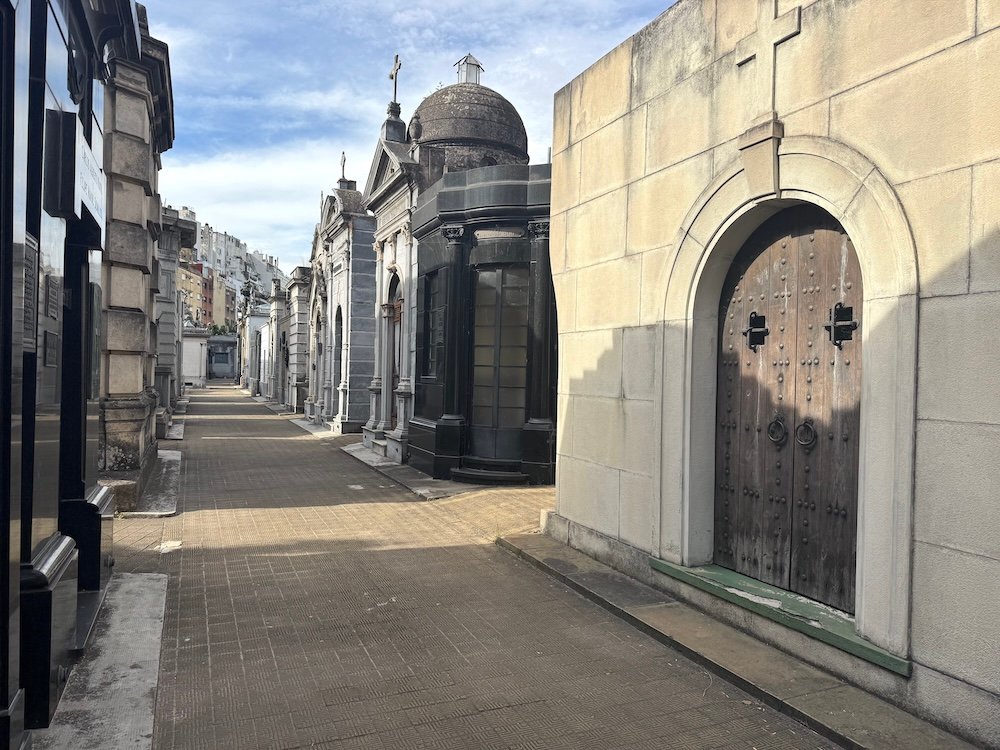
Still, there are nearly 5000 people buried in the more than mausoleums at Recoleta Cemetery. In my opinion, this is what makes Recoleta different from many other cemeteries that you may have been to. Rather than individual graves, the cemetery is lined with streets of mausoleums, with each mausoleum holding multiple people.
Typically what would happen is that a family would purchase a plot for a family member. They’d then have a mausoleum constructed for that family member. Then, as time passed, more family members would be buried there when they passed away. And keep in mind I said buried. People are not cremated and their bodies are interred intact into these mausoleums.
If you look at these mausoleums and wonder so many people could fit inside, there is a method. The bodies are not cremated and are still placed in coffins. The key is that these mausoleums aren’t just the ground floor, there’s two or three floors of hidden below ground.
If you peer inside any of these mausoleums, you’ll see a grate on the floor. This opens up to provide access to the floors below. At the time I visited, there was a new mausoleum being constructed (which in itself is highly unusual), but the owners and builders knew that people were curious about it so they provided the construction plans to show what a mausoleum here would actually look like.
While you may think that Recoleta Cemetery is reserved for just the most rich and famous people of Buenos Aires, that’s not entirely true. Anyone could purchase a plot and build a mausoleum here. So while you will find several notable names within the cemetery’s walls, there are plenty of more “every day” people that you won’t have heard of.
What to See at Recoleta Cemetery
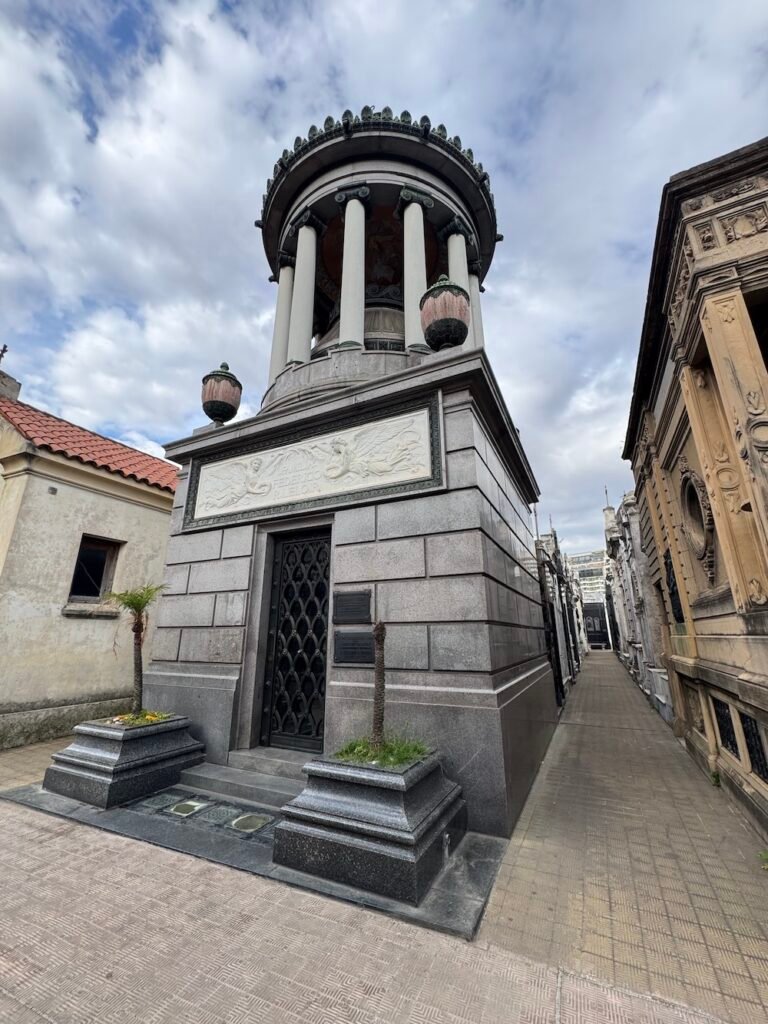
There is exactly one thing to see at Recoleta Cemetery and it’s the mausoleums. The pathways are lined with mausoleums holding the remains of many wealthy residents of the city. Now, these mausoleums are works of art in their own right, but for most visitors, it’s about who is interred in the mausoleums.
Here’s just a few of the more notable people buried in Recoleta Cemetery.
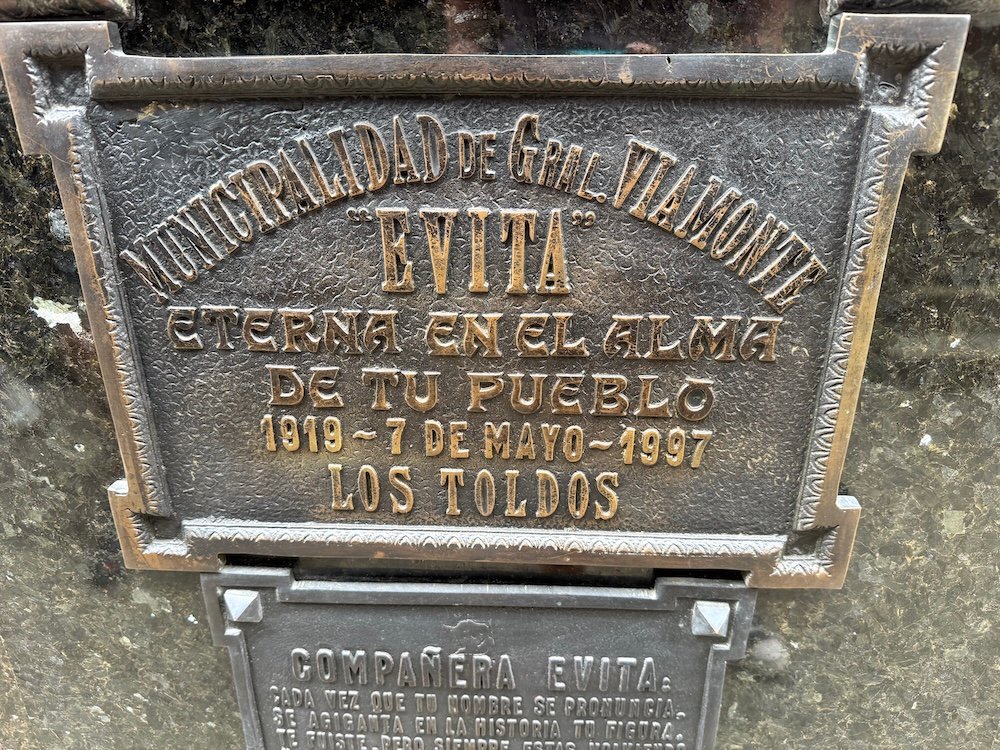
Eva Peron – By far and away the most notable person buried in Recoleta Cemetery is Eva Peron, the wife of former Argentinian President Juan Peron. She was an actress and philanthropist and the inspiration for the musical “Evita”. She died at age 33 from uterine cancer.
After her death, the city had planned to build a memorial, but her body was stolen and she was buried under an assumed name in Milan, Italy. Sixteen years later, her body was found and flown to Spain where Juan Peron had been living in exile. Later, Eva’s body finally made it back to Argentina.
What I find the most fascinating is that so many people come to Recoleta to see the grave of Eva Peron, but the mausoleum where she is interred isn’t even the most spectacular. In fact, it’s pretty average. This is because Eva Peron is buried in the Durate family mausoleum. Eva’s sister was the one who eventually worked out a deal with the government to bring Eva back to Argentina and have her buried in Argentina in the family mausoleum.
Luis Ángel Firpo – Another notable person buried in Recoleta Cemetery is Luis Ángel Firpo. He was a famous boxer who was the first Latin American boxer to ever challenge for the world heavyweight title. He competed against famed American boxer Jack Dempsey. Dempsey won, but even decades later, there’s still controversy about the fight and whether Dempsey was given unfair advantages. His mausoleum features a life-size statue of the boxer.
Carlos Saavedra Lamas – There are many politicians buried in Recoleta Cemetery. In fact, more than 25 Argentinian Presidents are buried here, but Carols Saavedra Lamas is a bit unique among politicians as he is the first Latin American winner of the Nobel Peace Prize.
Dorrego-Ortiz Basualdo – You probably haven’t heard of Dorrego-Ortiz Basualdo, but I’m including him in this list because his family’s mausoleum is the largest at Recoleta Cemetery. Not only is it the largest mausoleum, but it’s also one of the most impressive.
Entrance Fees for Recoleta Cemetery
While Recoleta Cemetery used to be free, there is now an entrance fee for foreigners. At the time of writing, that fee is 22,600 ARS and must be paid by card. In my opinion, it’s a bit of a steep fee (especially since it cost more than my tour guide), but the government claims that the tourist fees will be invested back in the cemetery (my tour guide is skeptical about this).
Do You Need a Guide for Recoleta Cemetery?
This really depends on the person, but in general, I would recommend taking a guided tour of Recoleta Cemetery. You don’t have to take a guided tour, but I think you get so much more out of your visit by having a guide who can give you context and tell you stories about some of the mausoleums in the cemetery.
After a lot of deliberation, I decided to go with a guide and went with Buenos Aires Walking Tours. The company offers both free and paid walking tours. The Recoleta Cemetery Tour is one of their paid tours and costs 14,000 pesos (or $10 USD) at the time of writing. While you can book for free, I found that the company didn’t really care so much about bookings and as long as you showed up on time, they were happy to bring you along. I registered for my first tour with them (their free Buenos Aires City Tour), but later I just showed up and paid at the end for my other tours (Recoleta Cemetery and San Telmo).
Note that Buenos Aires Walking Tours is not the only company providing tours of Recoleta Cemetery. You can find other tours online and there will undoubtedly be guides waiting at the front of Recoleta Cemetery waiting to be hired.
Is it Worth Visiting Recoleta Cemetery?
Recoleta Cemetery often shows up on lists of things to do in Buenos Aires and many will consider it a must do. I’m torn. I’m glad I visited (and even more glad that I took a tour), but I don’t think it’s a place I will revisit on a return trip to Buenos Aires. Once was enough for me.
I think the most important thing to remember is that Recoleta Cemetery is still a cemetery that is being used. While there aren’t as many burials here as in the main public cemetery, people are still buried here. So it’s not just a tourist attraction (and it was never intended to be one). It’s a place where people are laid to rest, so treat the place with respect.
More in Buenos Aires
Buenos Aires is a massive city with so much to see and do. For tourists, they’ll want to focus on the architecture of Recoleta, the Sunday Market in San Telmo, the history of La Boca, and the culture of Palermo. There are of course more neighborhoods and things to do beyond these four, but for people planning their first trip to Buenos Aires, this is where I’d start.
To get your bearings, I recommend taking a walking tour. I used Buenos Aires Walking Tours both for their Recoleta Cemetery tour and for two of their other tours (their free City Tour and their San Telmo Tour).
Final Thoughts
I’m glad I added a visit to Recoleta Cemetery to my Buenos Aires itinerary, but I’m even more glad that I decided to visit with a guided tour. The stories our guide told helped to give context to the graves and mausoleums that we were looking at. So, I recommend that for you as well. If you’re going to pay the fee to visit Buenos Aires’ most famous cemetery, splurge a little extra to learn just a bit more about it.
Continue Your Adventure
Buenos Aires: Nearly every trip to Argentina includes time in Buenos Aires. Learn how to spend two days in Buenos Aires.
Salta: Use this five day Salta itinerary to start planning your trip. There are loads of great things to do in Salta including museums and cable cars. Salinas Grandes has some of the world’s largest salt flats, Cafayate is famous for its wineries, and Cachi has cacti, canyons, and more.
