
The Tatacoa Desert was one of the things I was most excited for when I planned my second trip to Colombia. The scenery looked stunning in photographs and I’m happy to report that in person, it was just as incredible. It takes a bit of effort to get out to the Tatacoa Desert, but your reward is stunning scenery and a place that can feel just a bit off the traditional tourist trail.
What is the Tatacoa Desert
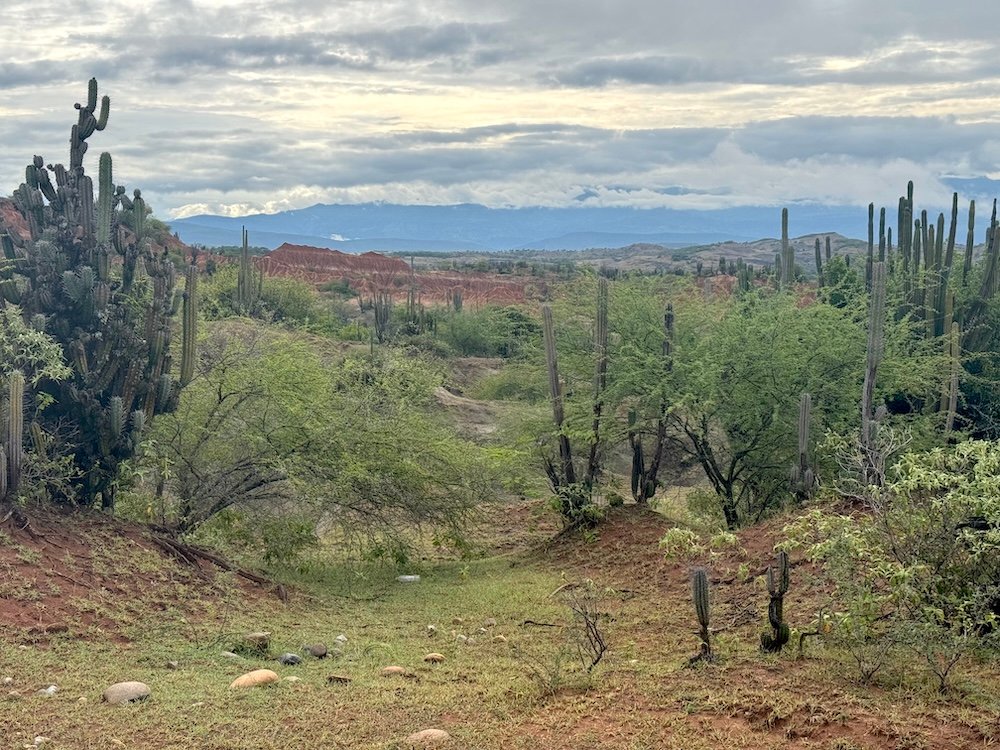
Let’s get one thing cleared up before we get too far into it. The Tatacoa Desert isn’t actually a desert. It’s not actually dry enough to meet the criteria for a desert and is instead considered a dry forest. For me, this makes more sense since I spent two nights in Villavieja, right near the Tatacoa Desert and we had rain both nights which led to quite a bit of mud in the mornings.
Even though it’s not technically a desert, tourists and locals alike will still refer to it as such.
What to See in the Tatacoa Desert
Let’s talk about what you should see in the Tatacoa Desert. Sights are light and everyone typically visits the same sights, but they are all so worth it. Later, I’ll talk about how to get around the desert.
Red Desert (Desierto Rojo)
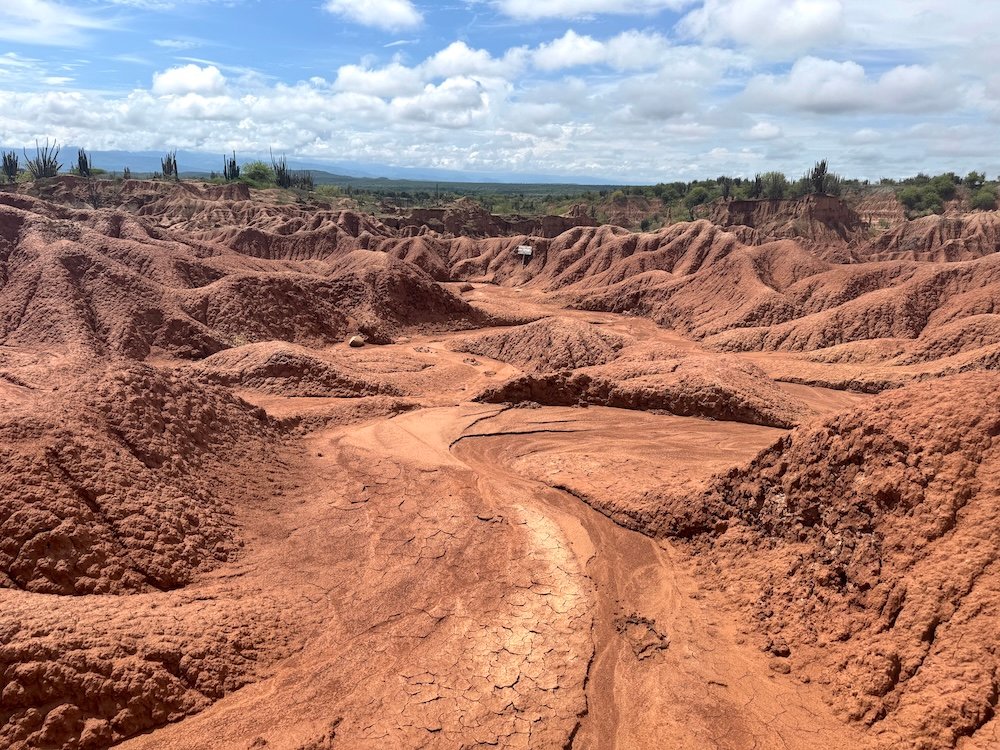
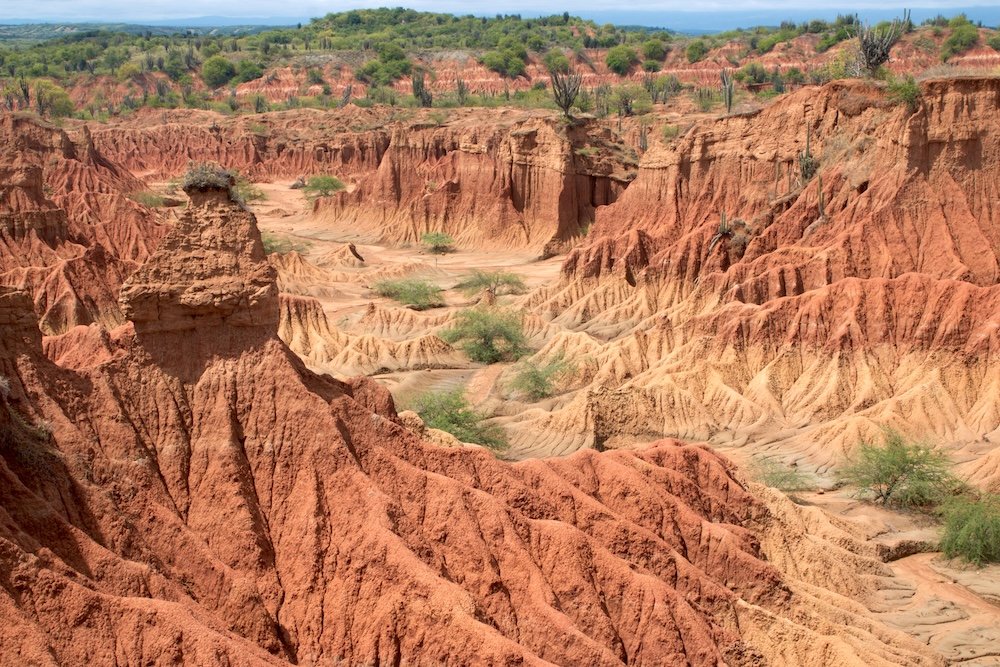
The place I want to mention is what I think has the most iconic views of the Tatacoa Desert, and that’s the Red Desert. The packed red sand forms unique landscapes and it’s truly breathtaking. There are plenty of places to stop and see these formations, and your driver will undoubtedly stop at some of them.
There is also a 2 mile trail that includes some of the best views. It’s up to you if you hike this trail, but even if you take in the views from the top (overlooking the trail), it’s absolutely incredible. These views from the top were some of my favorite scenery of the entire Tatacoa Desert.
On my visit, we stopped for a few views of the Red Desert en route to the Gray Desert. Then, on the way back, we stopped at some of those views and for the trail. Oh my gosh, these were the best of the day and it truly felt like we had saved the best for last.
Gray Desert (Los Hoyos, or Desierto Gris)
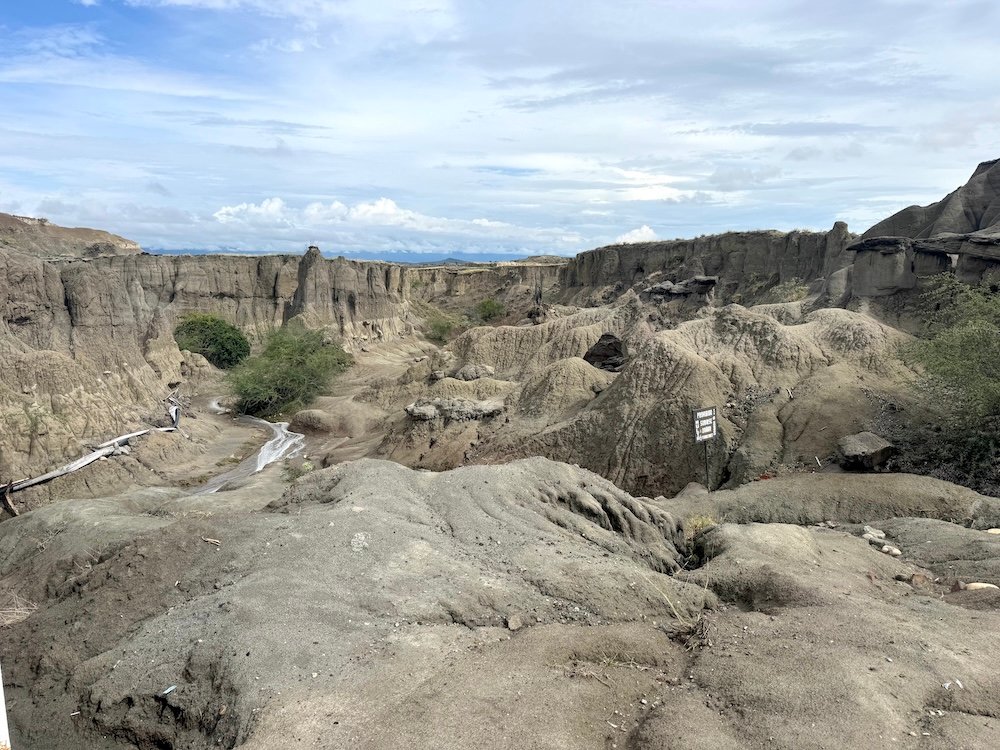
Just a little bit down the road from the Red Desert is the Gray Desert, also known as Los Hoyos. Despite their close proximity, these two areas feel like completely separate planets. While the Red Desert is lined with the red clay, the Gray Desert, as the name suggests, is gray. While the features of the Gray Desert are cool, it doesn’t feel quite as dramatic as the Red Desert.
At the Gray Desert, you can do a one mile loop that takes you through some of the best scenery. The views are ever changing and incredible. I couldn’t believe how different it felt from the Red Desert.
When I visited, it had rained in the early morning, which made for a muddy trail. I was constantly shaking mud and packed clay off my hiking shoes. That’s not quite what I expected when I decided to visit a “desert”.
Note that there is also a swimming pool in the Gray Desert. You’ll pay a fee to enter and swim, but there’s some debate about whether having a pool here for tourists is a great idea because of the water required to sustain it. Whether you swim is up to you.
Xilópalos Valley Trail
This trail is off the beaten path. Most visitors, myself included, just stick to the Red and Gray Deserts, but if you go just a little bit further, there’s one more hiking trail that you can do. Based on reviews, it’s not as good as the Red or Gray Deserts, but it’s still a nice trail. That said, the reviews I’ve read also mentioned mud, and since it had rained early in the morning of my visit and we had plenty of mud on the trail through the Gray Desert, I’m not upset that I skipped this trail.
Stargazing
There’s very minimal light pollution out in the Tatacoa Desert which makes it ideal for stargazing. If you’re staying at a hotel in the desert, you might be able to do some stargazing right from your hotel, but for those staying in Villavieja, you can hire a tuktuk to take you out into the desert.
While you could just stay on the side of the road, there are observatories in the desert that give talks every night and can be a great option.
I’ll be honest and admit that I skipped the stargazing on my trip to the Tatacoa Desert. While I would have loved to see those awesome starry skies, it was decently cloudy on my visit and heading out for stargazing just didn’t seem like it would be well worth it. If you have a clear night though, absolutely hire a tuktuk and head out into the desert.
Where to Stay in the Tatacoa Desert
You have three major options for where to stay on your Tatacoa Desert adventure.
Option one is to stay in Neiva. This is the closest major city and you could day trip out to the desert from your hotel in Neiva. If you choose this method, I’d recommend going with a guided tour just to make the best use of your time. Also note that you’ll want to get an early start. The Tatacoa Desert gets very hot and from Neiva, you’ll have at least an hour and a half of travel time just to reach the desert.
Option two is the small town of Villavieja. This is where I stayed when I visited the desert. It’s not quite in the desert, but it’s the closest town to the desert. So if you want a few creature comforts (like air conditioning, decent WiFi, and a few restaurants to choose from), Villavieja may be the spot for you. It’s located about an hour or so outside of Neiva.
Option three is to stay in the desert. There are numerous hotels and hostels that are actually located in the desert. The benefit here is that you’re already in the desert and you’re away from light pollution which can lead to some incredible stargazing. The downside is there’s not much around so you’ll need to rely on your accommodation for most things including food, water, and transportation.
How to Get Around the Tatacoa Desert
If you have your own vehicle, you’re set. For almost all other travelers you’ll be taking some kind of tour. While there are guided tours that go out to the desert, it’s actually quite easy to get a private tour. Tuktuks and moto taxis are available for hire in the main square and will gladly take you out into the desert. It’s actually so popular that there are several tour options in the price sheet in the back of the tuktuk.
If you use the tuktuks (which are definitely the easiest), don’t expect an English speaking driver. However, they will take you to whichever stops you want and will wait for you at each stop while you take your photos and explore. So how much does this cost? It can range anywhere from 120,000 to 200,000 COP, depending on exactly what you want to do.
I arranged my tour through my hotel. It was pretty similar to what you would get by just hiring a tuktuk in the square, but the benefit was that when I was ready to leave at 8:00 am, the tuktuk and driver were already in my hotel and we could leave without any negotiation. That was a huge benefit.
I paid 150,000 COP for my private tour and thought it was a great value. My driver only spoke Spanish, but I spoke enough Spanish to get the gist of what he was saying. Often he would have me get out of the tuktuk and walk to take my time and take my photos. He’d then meet me up ahead, which was great.

How to Get to the Tatacoa Desert
Most people will get to the Tatacoa Desert via the nearby city of Neiva. There are numerous bus connections here, so step one will definitely be getting to Neiva from wherever you’re starting from. I was able to catch buses from Armenia (after transferring to Armenia from Salento) and to Bogotá with ease. Then in Neiva, you can catch a colectivo to Villavieja.
Two notes on the colectivo. First, there is no set schedule. The colectivo leaves when it’s full so you might wait ten minutes or you might wait three hours. I got to the bus station at about 10:30 am and had to wait for about an hour until there were enough passengers.
Also note that the colectivos do not run all day. I’ve seen various reports but in general, the colectivos to Villavieja stop running sometime between 5:00 or 6:00 pm. If you miss the last colectivo, you’ll either be stuck in Neiva for the night or will need to pay for an expensive taxi to Villavieja (which can cost 100,000+ COP).
My other note for the colectivo is to ask someone working at the station where to find it. The colectivo is operated by Coomotor but they have numerous desks throughout the bus station and of course, the bus for Villavieja is hidden in one of the corners of the station. Just ask and any of the people at the station will show you exactly where to go.
One other option is to skip Neiva. Instead of going to Neiva, get off the bus in Aipe. From there, you’ll need to catch a mototaxi to go to the ferry stop and then take a ferry across the river to Villavieja. I didn’t do this, but there were a few travelers on my bus who did. Like with Neiva, be aware of the last ferry crossing for the evening.
Final Thoughts
I loved my visit to the Tatacoa Desert. The scenery is incredible and felt so different from everything else I had seen in Colombia. Even within the desert, the scenery varied greatly and it was a perfect way to spend a day, even if it took a lot of effort to reach the desert.
Continue Your Adventure
Colombia: Start planning your trip with my Colombia Travel Guide which includes a realistic travel budget, my top travel tips, safety information, a nine day itinerary, and so much more.
